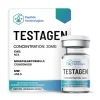


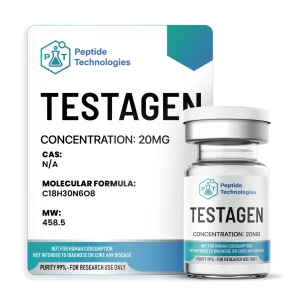

Testagen 20mg
$39.95
Explore Testagen 20 mg from Peptide Tech Solutions, a premium tetrapeptide designed for research use. With over 99% purity and precise packaging, it’s perfect for in-vitro studies, including peptide-DNA interactions and endocrine cell models. Get your Testagen today for reliable research results!
Testagen 20 mg (KEDG; Lys–Glu–Asp–Gly) from Peptide Tech is a premium, lyophilized research-use-only (RUO) tetrapeptide supplied at ≥99% purity (HPLC & MS verified). This sequence-defined bioregulatory peptide is packaged for precise in-vitro studies in peptide–DNA interactions, nuclear localization assays, endocrine cell models, and analytical method development—backed by batch traceability and validated cold-chain logistics.
Specifications
| Property | Details |
|---|---|
| Product | Testagen — lyophilized powder (20 mg) |
| Chemical Name | H-Lys-Glu-Asp-Gly-OH |
| Synonyms | KEDG; “anterior pituitary peptide” (literature); Lys-Glu-Asp-Gly |
| Sequence | Lys–Glu–Asp–Gly (K-E-D-G) |
| CAS Number | Not assigned (sequence-defined RUO tetrapeptide) |
| PubChem CID | No consolidated entry for this exact sequence |
| Molecular Formula | C17H29N5O9 |
| Molecular Weight | ≈ 447.4 g/mol |
| Appearance | White to off-white lyophilized powder |
| Content per Vial | 20 mg |
| Container | 3 mL Type I glass vial; butyl stopper; flip-off seal |
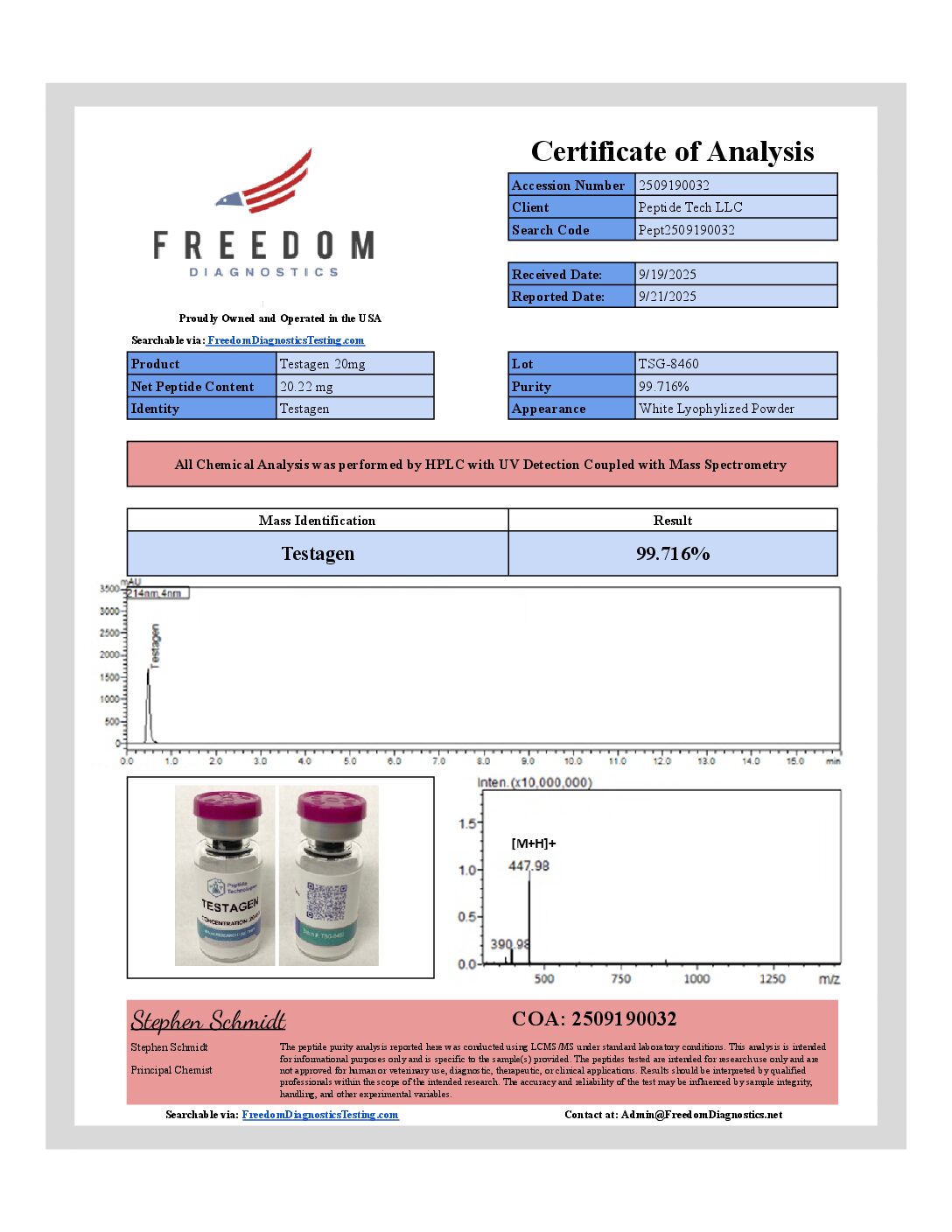
| Purity / Identity | ≥99% by HPLC; identity by MS (batch COA via on-vial QR) |
| Counter-ion | Typically acetate (verify on lot COA) |
| Solubility | Soluble in sterile water or neutral buffers; for rapid wetting at high concentration, pre-wet with ≤0.1% acetic acid, then bring to buffer. Filter (0.22 µm) if sterility is required by your SOP. |
| Storage (lyophilized) | −20 °C long-term (desiccated, light-protected) |
| After Reconstitution | Aliquot; store at ≤−20 °C (or −80 °C per SOP); avoid repeat freeze–thaw |
| Intended Use | RUO only. Not for human or animal use. |
Molecular Structure
A single, imageable PubChem record is not available for the exact KEDG sequence at this time. Sequence and lot-specific analytics (HPLC/MS) are provided via the QR-linked COA for structural/identity verification.
Key Features of Peptide Tech
- Same-Day Shipping (Mon–Fri, on in-stock items)
- GMP-Aligned lyophilization & documentation
- USA-Made peptides
- 24/7 Support & Price Match Guarantee
- Batch QR for instant COA & chain-of-custody verification
- 3rd-Party U.S. Lab Testing — purity, quantity, endotoxin
- Cold-Chain Shipping — Always (no paid upgrade)
- Worldwide Shipping; all major payments accepted
- Text & Email order updates; 2-Day FedEx/UPS standard with low-cost overnight
- Largest Variety of peptides & bioregulators
Potential Applications in Research (RUO)
Strictly for in-vitro, cell-based, or biochemical workflows. No health, diagnostic, or therapeutic claims.
- Nuclear localization & uptake — replicate fluorescence-labeling assays (e.g., HeLa) to quantify cellular and nuclear entry of KEDG vs. control peptides and analyze peptide–DNA/oligonucleotide binding in vitro.
- Endocrine pathway panels — in pituitary/thyroid cell lines or primary cultures, map KEDG-conditioned readouts (e.g., transcriptional reporters, qPCR, ELISA) under defined media and stimulus conditions.
- Peptide–DNA interaction screens — assess sequence-selective binding to dsDNA or oligos (fluorometric displacement, EMSA) and compare against related short peptides to build SAR hypotheses.
- Transport & permeability models — characterize membrane transit and endosomal escape using live-cell imaging, FRAP, and peptide-tracking controls.
- Analytical method development — establish RP-HPLC and LC–MS(/MS) methods for identity, purity, recovery, and stability (forced-degradation, pH, temperature) for a small, polar tetrapeptide matrix.
- Surface/biophysical studies — examine adsorption/interaction behavior on model surfaces (e.g., electrochemical and isotherm analyses) to inform peptide–material interfaces.
Citations (MLA)
- Fedoreyeva, L. I., et al. “Penetration of Short Fluorescence-Labeled Peptides into the Nucleus in HeLa Cells and In Vitro Specific Interaction of the Peptides with Deoxyribooligonucleotides and DNA.” Biochemistry (Moscow), vol. 76, no. 11, 2011, pp. 1210–1219. https://doi.org/10.1134/S0006297911110022
- Kuznik, I., A. V. Pateyuk, and N. S. Rusaeva. “Effect of Tetrapeptides Lys–Glu–Asp–Gly and Ala–Glu–Asp–Gly on the Hormone-Producing Function and Morphology of the Thyroid Gland of Hens.” Bulletin of Experimental Biology and Medicine, vol. 145, 2008, pp. 152–156. https://doi.org/10.1007/s10517-008-0033-6
- Baranchugova, M., and V. I. Obydenko. “The Effect of Lys–Glu–Asp–Gly and Ala–Glu–Asp–Gly Peptides on Hormone-Producing Function of the Thyroid in Sexually Mature and Old Hens.” Cell and Tissue Biology, vol. 5, no. 4, 2011, pp. 417–425. https://link.springer.com/article/10.1134/S2079057011040072
- Khavinson, V. Kh., and N. M. Linkova. “Peptide Regulation of Cell Differentiation.” Biochemistry (Moscow), vol. 85, 2020, pp. S1–S15. PDF
- Bicǎ, D., et al. “The Inhibitory Effect and Adsorption Properties of Testagen (KEDG) Peptide on Copper Surfaces.” Molecules, vol. 30, no. 15, 2025, Article 3141. https://doi.org/10.3390/molecules30153141
Quality, Storage & Handling
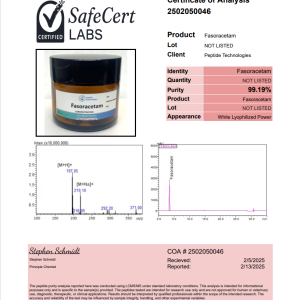
Every lot is confirmed by HPLC (purity) and MS (identity) with independent U.S. lab testing for purity, quantity, and endotoxin. Access batch documentation instantly via the on-vial QR code.
- Reconstitution: Bring vial to room temperature; add sterile water (or ≤0.1% acetic acid to pre-wet), then adjust into your assay buffer. Mix gently (no vigorous vortexing); brief sonication can help stubborn pellets.
- Aliquoting: Prepare single-use aliquots immediately after dissolving to minimize freeze–thaw exposure.
- Controls: Include scrambled or related short-peptide controls for mechanistic interpretation; document buffer composition, pH, and ionic strength.
Shipping & Fulfillment
Ships with validated cold-chain packaging. In-stock orders placed before the daily cutoff ship the same day. 2-Day FedEx/UPS is standard; overnight options available. Automated text/email updates included; international shipping available where permitted.
Compliance & RUO Notice
For laboratory research only. Not a drug, cosmetic, food, or household chemical. Not for human or animal use, ingestion, diagnostic, or therapeutic applications. Purchaser warrants appropriate qualifications and compliance with applicable regulations and institutional policies.
FAQs
- Is Testagen the same as Epitalon or Pinealon?
- No. Testagen is the tetrapeptide Lys–Glu–Asp–Gly (KEDG). Epitalon is Ala–Glu–Asp–Gly (AEDG), and Pinealon is Glu–Asp–Arg (EDR). Verify the exact sequence required by your protocol.
- Do you provide a PubChem structure image?
- PubChem does not currently host a consolidated entry for this exact KEDG sequence. Identity is documented via HPLC/MS on the QR-linked COA. If you require a drawn structure for a report, contact support and we’ll provide an SVG based on the sequence.
- What purity do you provide?
- Each 20 mg vial is ≥99% by HPLC with MS identity confirmation; third-party testing is performed on every lot (COA via on-vial QR).
- Which in-vitro assays are common?
- Typical RUO uses include fluorescence-tracked nuclear uptake, peptide–DNA interaction assays, endocrine pathway readouts in cell culture, and LC–MS/HPLC method development (see citations above).
Explore More
Browse additional research peptides and accessories at Peptide Tech.
Related Products
Browse more in Bioregulators.
Always read the label and use products as directed. Consult a qualified professional where appropriate.
Related products