



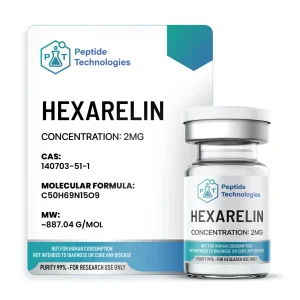

Hexarelin 2mg
$19.95
Hexarelin 2 mg, also known as Examorelin, from Peptide Tech Solutions is a high-quality peptide suitable for research purposes. This synthetic hexapeptide, with a purity level of ≥99% as verified by HPLC and MS, is designed for in-vitro receptor-signaling and ligand-binding workflows. Its unique structure (His-D-2-Me-Trp-Ala-Trp-D-Phe-Lys-NH2) makes it a selective agonist of the GHSR1a receptor, enhancing your peptide research capabilities.
Overview
Specifications
| Property | Details |
|---|---|
| CAS Number | 140703-51-1 |
| Chemical Name | L-Histidyl-2-methyl-D-tryptophyl-L-alanyl-L-tryptophyl-D-phenylalanyl-L-lysinamide (Examorelin) |
| PubChem CID | 6918297 |
| Molecular Formula | C47H58N12O6 |
| Molecular Weight | ~887.04 g/mol |
| Physical Appearance | White to off-white lyophilized powder |
| Sequence | His-D-2-Me-Trp-Ala-Trp-D-Phe-Lys-NH2 |
| Container | 3 mL glass vial (2 mg net content) |
| Purity | ≥99% verified by HPLC & MS (lot COA via QR) |
| Solubility | Water-soluble; optimize buffer and pH for your assay. Reference |
| Intended Use | Laboratory research only. Not for human or animal use. |
Molecular Structure

Key Features of Peptide Tech
- Same-Day Shipping (Mon–Fri, on in-stock items)
- GMP-Aligned Lyophilized Peptides
- USA Made
- 24/7 Support
- Price Match Guarantee
- Batch Tracking with QR Code Verification
- 3rd-Party U.S. Lab Testing — purity, quantity, endotoxin
- Cold-Chain Shipping — Always (no paid upgrade)
- Worldwide Shipping
- All Major Payments Accepted
- Text & Email Order Updates
- 2-Day FedEx/UPS Shipping Standard
- Cheapest Overnight Rates
- Largest Variety of Peptides & Bioregulators
Potential Applications in Research
Strictly in-vitro, cell-based, or biochemical experiments. No health claims or clinical/veterinary use.
- GHSR1a calcium-mobilization assays in GHSR-expressing cells (e.g., CHO/HEK293) using fura-2 or GECI readouts to quantify agonist potency and acute receptor desensitization.
- Receptor internalization & beta-arrestin recruitment (confocal/BRET/ELISA) to profile GHSR1a trafficking and biased signaling after exposure.
- Radioligand & competition binding using iodinated analogs for saturation and competition binding in membrane preparations.
- Pathway mapping (e.g., PLC/IP3–Ca2+, ERK/Akt) in heterologous or pituitary-derived lines to dissect downstream signals after GHSR1a activation.
- Analytical method development (LC–MS/MS) for detection and quantitation of hexarelin and related GHRPs in lab matrices.
Quality, Storage & Handling
Every lot is confirmed by HPLC (purity) and MS (identity); batch-level COA is accessible via on-vial QR. Third-party U.S. laboratories verify purity, quantity, and endotoxin.
- Storage (lyophilized): −20 °C long term or 2–8 °C short term; keep desiccated and light-protected.
- After reconstitution: Aliquot and store at ≤−20 °C; avoid repeated freeze–thaw cycles.
- Reconstitution tips: Use sterile water or suitable buffer; gentle inversion/brief sonication can aid dissolution; filter-sterilize if required.
Shipping & Fulfillment
Ships with validated cold-chain packaging. In-stock orders placed before the daily cutoff ship the same day. 2-Day FedEx/UPS is standard, with overnight options available. Automated text/email updates included; international shipping available where permitted.
Compliance & RUO Disclaimer
For laboratory research only. Not a drug, cosmetic, food, or household chemical. Not for human or animal use, clinical, veterinary, or diagnostic applications. Buyers warrant they are qualified to handle RUO materials per applicable laws and institutional guidelines.
FAQs
- Is this for human or veterinary use?
- No. This product is sold strictly as RUO and must not be used in humans or animals.
- What purity do you provide?
- Each 2 mg vial is ≥99% by HPLC with MS identity confirmation; third-party testing is performed on every lot (see COA via QR).
- How should I reconstitute it?
- Use sterile water or compatible buffer; gently invert until dissolved. If your protocol requires, 0.22 µm filter-sterilize and aliquot.
- What in-vitro assays is Hexarelin commonly used in?
- Typical RUO uses include GHSR1a Ca2+ signaling, receptor internalization/beta-arrestin studies, radioligand binding, and LC–MS/MS method development.
Explore More
Browse additional research peptides and accessories at Peptide Tech.
Related Products
Browse more in Peptides.
Always read the label and use products as directed. Consult a qualified professional where appropriate.
Related products