


Oxytocin 5mg
$29.95
Shop Oxytocin 5mg, a high-purity peptide (≥99%) ideal for your research needs. This cyclic nonapeptide serves as a key OXTR ligand, perfect for studying GPCR signaling and validating analytical methods. Buy now for reliable, reproducible results in your biochemical applications.
Oxytocin 5mg – 99% Pure Peptide for Sale
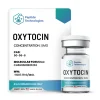
Elevate your studies with Oxytocin (CYIQNCPLG-NH₂), a cyclic nonapeptide supplied by Peptide Tech at ≥99% purity for precise, reproducible in-vitro, cellular, and biochemical applications. As a well-characterized OXTR (oxytocin receptor) ligand, Oxytocin is frequently used to probe GPCR signaling cascades, develop and validate analytical methods, and benchmark receptor-binding assays—without any clinical or human-use context.
SPECIFICATIONS TABLE
Property: Details
— CAS Number: 50-56-6
— Chemical Name: L-cysteinyl-L-tyrosyl-L-isoleucyl-L-glutaminyl-L-asparaginyl-L-cysteinyl-L-prolyl-L-leucyl-glycinamide (disulfide bridge Cys¹–Cys⁶)
— PubChem CID (clickable): PubChem CID 439302 — https://pubchem.ncbi.nlm.nih.gov/compound/Oxytocin
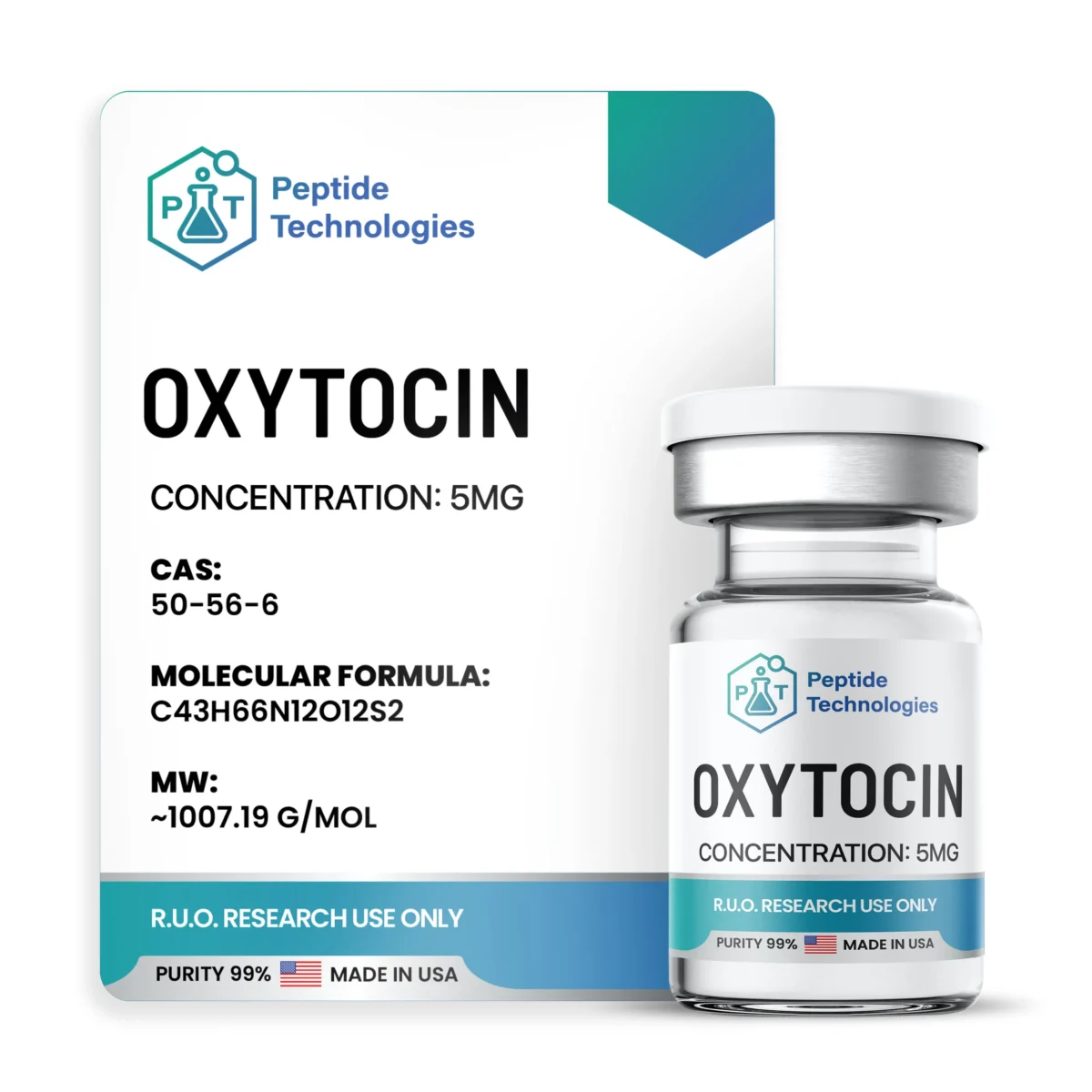
— Molecular Formula: C43H66N12O12S2
— Molecular Weight: 1007.19 g/mol
— Physical Appearance: White to off-white lyophilized powder
— Sequence: Cys–Tyr–Ile–Gln–Asn–Cys–Pro–Leu–Gly–NH₂ (CYIQNCPLG-NH₂)
— Container: 3 mL glass vial (5 mg net content)
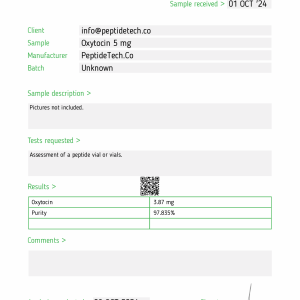
— Purity: ≥99% (verified by HPLC & MS)
— Solubility: Soluble in sterile water or compatible aqueous buffer; gently agitate until fully dissolved; filter-sterilize if required
Specs validated via PubChem and a major reference supplier entry. (PubChem, MilliporeSigma)
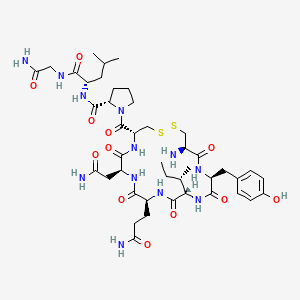
View the Oxytocin structure on PubChem: https://pubchem.ncbi.nlm.nih.gov/compound/Oxytocin. (PubChem)
OXYTOCIN BIOLOGICS

WHY PEPTIDE TECH
• Same-Day Shipping
• GMP-Aligned Lyophilized Peptides
• USA Made
• 24/7 Support
• Price Match Guarantee
• Batch Tracking with QR Code Verification
• Third-Party USA Lab Testing — purity, quantity, endotoxin
• Cold Chain Shipping — Always (No Paid Upgrade)
• Worldwide Shipping
• All Major Payments Accepted
• Text & Email Order Updates
• 2-Day FedEx/UPS Shipping Standard
• Cheapest Overnight Rates
• Largest Variety of Peptides & Bioregulators
PRODUCT OVERVIEW
Oxytocin (nonapeptide, cyclic) is a reference ligand for OXTR widely used to interrogate Gq/PLC–Ca²⁺ and downstream ERK/MAPK signaling in receptor-positive cell models. Its compact sequence and robust literature record make it a dependable control for receptor-binding, functional readouts (e.g., intracellular Ca²⁺ flux), and method development in analytical labs. Peptide Tech pairs high analytical confirmation (MS/HPLC) with cold-chain fulfillment to protect peptide integrity from our facility to your bench.
POTENTIAL APPLICATIONS IN RESEARCH
• GPCR signaling dissection in OXTR-expressing cell lines, mapping PLC–IP₃–Ca²⁺ flux and ERK/MAPK activation via reporter assays, Westerns, or live-cell imaging. (PMC, PubMed)
• Radioligand or competition-binding assays to quantify OXTR affinity/selectivity and derive Kd/Ki values for candidate ligands or tool compounds. (PubMed)
• 3D spheroid/phenotypic models evaluating OXTR-mediated morphological responses and cell-level signaling outcomes under controlled in-vitro conditions. (PMC)
• Analytical method development and validation (e.g., LC–MS/MS, RIA/ELISA) for peptide detection, extraction recovery, matrix effects, and quantitation performance. (PMC)
• Calcium-imaging workflows (e.g., ratiometric dyes or GECIs) to benchmark ligand-evoked Ca²⁺ transients downstream of OXTR activation. (PMC)
CITATIONS
Gárriz, Agustina, et al. “Role of the Phospholipase C Pathway and Calcium in Oxytocin-Induced Cellular Responses.” Biomedicines, vol. 9, no. 11, 2021, Article 1584. https://pmc.ncbi.nlm.nih.gov/articles/PMC8626846/. (PMC)
Rimoldi, Valentina, et al. “Oxytocin Receptor Elicits Different EGFR/MAPK Activation Patterns Depending on Membrane Localization.” Journal of Neurochemistry, vol. 86, no. 4, 2003, pp. 974–985. https://pubmed.ncbi.nlm.nih.gov/12955084/. (PubMed)
Pettibone, Douglas J., et al. “Identification of Functional Oxytocin Receptors in Lactating Rat Mammary Gland: Radioligand Binding and Functional Assays In Vitro.” Endocrinology, vol. 127, no. 2, 1990, pp. 780–788. https://pubmed.ncbi.nlm.nih.gov/2163875/. (PubMed)
Werry, Emma L., et al. “Measuring Affinity of Ligands to the Oxytocin Receptor by Radioligand Binding.” Methods in Molecular Biology, vol. 2390, 2022, pp. 241–260. https://pubmed.ncbi.nlm.nih.gov/34550578/. (PubMed)
Hering, Alexander, et al. “Approaches to Improve the Quantitation of Oxytocin in Biological Matrices: An Analytical Perspective.” Journal of Neuroscience Methods, vol. 371, 2022, 109495. https://pmc.ncbi.nlm.nih.gov/articles/PMC9218718/. (PMC)
QUALITY, STORAGE & HANDLING
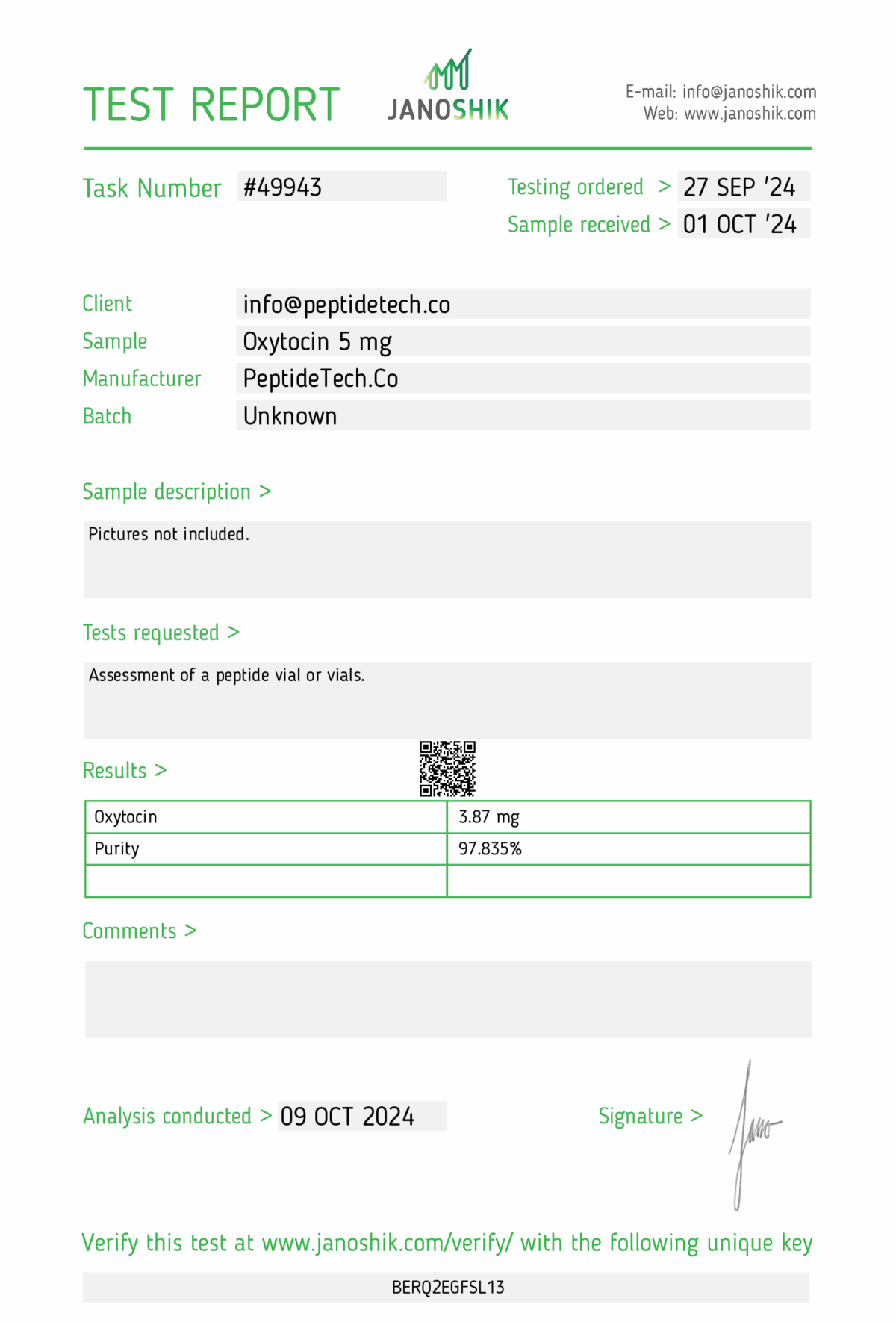
Each lot is verified by HPLC (purity) and MS (identity), with batch traceability via QR. Third-party U.S. labs test for purity, quantity, and endotoxin.
• Storage (lyophilized): −20 °C (long term).
• Storage (reconstituted): aliquot and store at −80 °C; avoid repeated freeze–thaw.
• Handling: Use sterile technique; select solvent/buffer appropriate to your assay; minimize exposure to moisture/heat.
SHIPPING & FULFILLMENT
Ships in cold-chain packaging by default. Same-day dispatch for in-stock items placed before daily cutoff; 2-Day FedEx/UPS standard with overnight options. Automated text/email updates and international service available where permitted.
COMPLIANCE & RUO DISCLAIMER
For laboratory research use only. Not for human or animal use, ingestion, diagnostic, or therapeutic applications. COAs and batch documentation available upon request or via QR.
FAQ
- Is this Oxytocin intended for human use?
No. It is sold strictly as RUO—not for human or animal use, ingestion, diagnostic, or therapeutic purposes. - What purity do you provide?
Each 5 mg vial is ≥99% by HPLC with MS identity confirmation and third-party testing; see the lot-matched COA via QR. - How should I reconstitute it?
Use sterile water or compatible aqueous buffer; gently invert until dissolved. Filter through 0.22 µm if your assay requires sterility. Avoid multiple freeze–thaw cycles by aliquoting. - What assays is Oxytocin commonly used in?
Typical in-vitro uses include OXTR binding, Ca²⁺ flux/PLC pathway readouts, ERK/MAPK signaling studies, and analytical method validation (e.g., LC–MS, RIA). (See citations above.)
Related Products
Browse more in Peptides.
Always read the label and use products as directed. Consult a qualified professional where appropriate.
Related products