

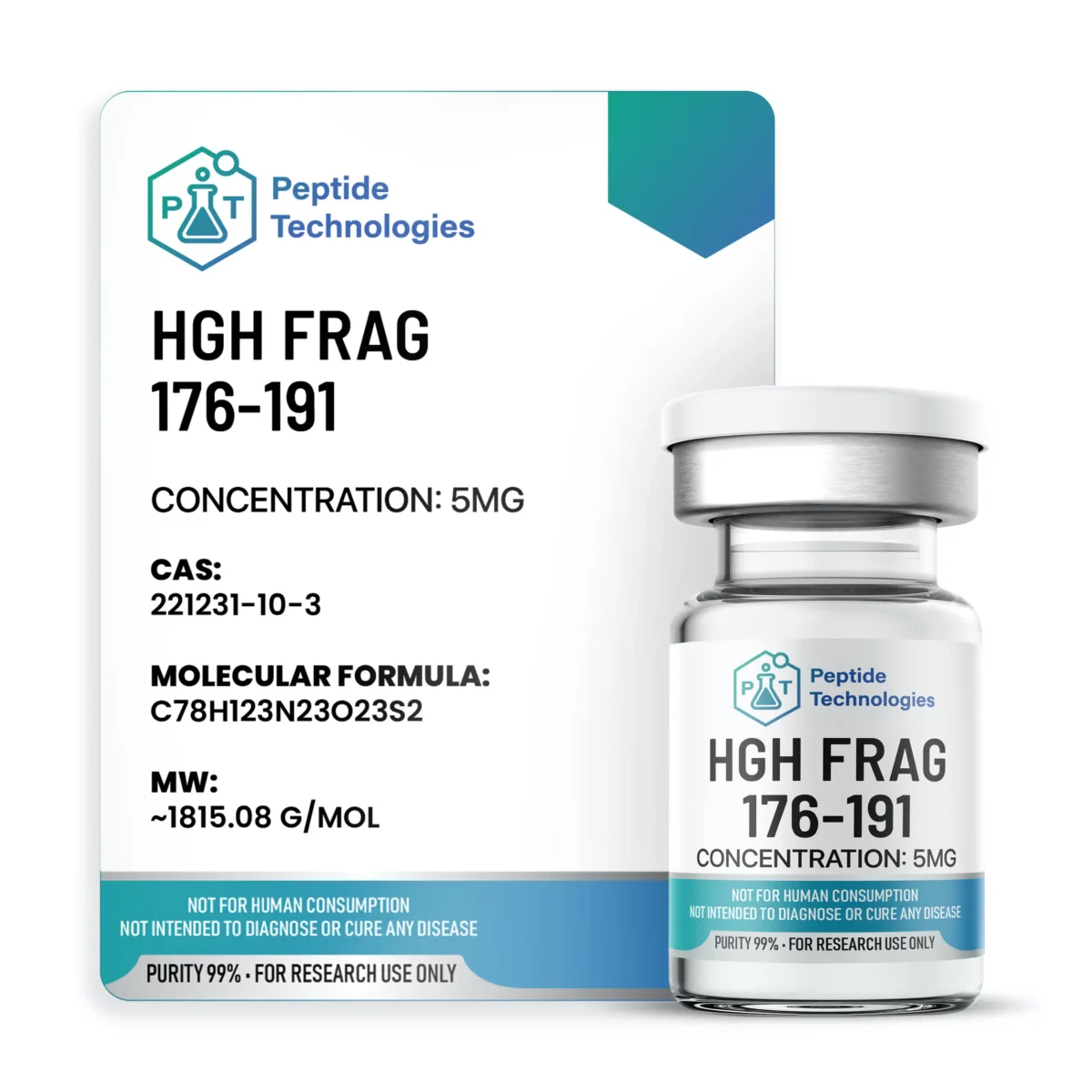
Fragment 176-191 5mg
$39.95
Fragment 176, 191 (hGH 176, 191) 5 mg is a highly purified peptide designed for in-vitro research. This 16-amino acid fragment corresponds to the C-terminal segment of human growth hormone and is available at ≥ 99% purity (HPLC/MS verified). Ideal for studies on lipid metabolism signaling and receptor interactions, you can explore its potential in your assays today.
Overview
Fragment 176–191 (hGH 176–191) 5 mg is a 16–amino acid peptide corresponding to the C-terminal segment of human growth hormone (residues 176–191). Supplied by Peptide Tech at ≥ 99% purity (HPLC/MS verified), this material is provided strictly for in-vitro, cellular, and biochemical research use only (RUO). Researchers commonly explore Fragment 176–191 in assays focused on lipid-metabolism signaling, structure–activity relationships (e.g., disulfide contribution), and receptor-proximal pathway readouts under controlled laboratory conditions.
Specifications
| Property | Details |
|---|---|
| CAS Number | 66004-57-7 source |
| Chemical Name | Somatotropin (176–191); hGH Fragment 176–191 |
| PubChem CID | CID 16131230 |
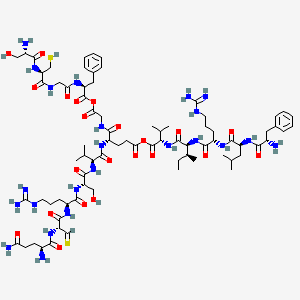
| Molecular Formula | C78H123N23O22S2 PubChem |
| Molecular Weight | ≈ 1799 g/mol ref |
| Sequence | H-Tyr-Leu-Arg-Ile-Val-Gln-Cys-Arg-Ser-Val-Glu-Gly-Ser-Cys-Gly-Phe-OH ref |
| Physical Appearance | White to off-white lyophilized powder |
| Container | 3 mL glass vial (5 mg net content) |
| Purity | ≥ 99% verified by HPLC & MS |
| Solubility | Soluble in sterile water or compatible aqueous buffer; gently invert until dissolved; filter-sterilize (0.22 µm) if required |
Molecular Structure
Storage & Handling
Lyophilized (unopened): Store at ≤ −20 °C in a dry, dark environment. Short-term storage at 2–8 °C is acceptable if the vial remains sealed and will be used soon.
Guidance
After reconstitution: Prepare sterile aliquots; store at ≤ −20 °C (≤ −80 °C recommended for long-term). Avoid repeated freeze–thaw cycles.
Allow vial to reach room temperature before opening to minimize condensation; mix gently—avoid aggressive vortexing.
Potential Applications in Research
Strictly in-vitro, cellular, or biochemical contexts — no clinical or human-use claims.
- Adipocyte lipid-metabolism assays: Quantify effects on lipogenesis vs. lipolysis (e.g., radiolabeled acetate incorporation, glycerol/NEFA release) in cultured fat pads or adipocytes;
C-terminal hGH fragments (e.g., 177–191) demonstrated antilipogenic activity in vitro.
Biochem. Mol. Biol. Int., 1993. - β3-adrenergic pathway readouts: Evaluate transcript/protein changes (β3-AR) and downstream markers alongside metabolic flux; analog Tyr-hGH(177–191) (AOD9604) has been studied for related endpoints in cell/rodent models.
Endocrinology, 2001. - Structure–activity investigations: Map the contribution of the disulfide and terminal residues to activity using truncated/modified analogs in lipogenesis assays.
Springer chapter (SAR), 2001. - Glycogenolysis/glycolytic profiling: Use hepatocyte or muscle-cell systems to study carbohydrate-metabolism effects reported for synthetic hGH 176–191/177–191 peptides in vitro.
Mol. Cell. Endocrinol., 1982. - Chemical identity & analytical control: Use PubChem CID and exact sequence for method validation (LC-MS/MS, HPLC retention mapping) and inter-lab comparability.
PubChem.
Citations
- Somatotropin (176–191) — PubChem Compound Summary (CID 16131230): identifiers, formula, structure.
PubChem - Heffernan-Stroud lab (SAR overview). “Development of a Human Growth Hormone Peptide Analogue AOD9604 into an Anti-Obesity Drug.” In: Peptides: The Wave of the Future. Springer, 2001.
PDF - Ng, F. M., et al. “Effects of Human GH and Its Lipolytic Fragment (AOD9604) on Lipid Metabolism.” Endocrinology, vol. 142, no. 12, 2001, pp. 5182–5189.
Abstract - Horowitz, M., et al. “Antilipogenic Action of Synthetic C-Terminal Sequence 177–191 of Human Growth Hormone: In Vitro Studies.” Biochemistry and Molecular Biology International, vol. 30, no. 1, 1993, pp. 187–196.
Europe PMC - Harvey, S., et al. “Mechanism of the Hyperglycaemic Action of Synthetic Peptides Corresponding to hGH 176–191 and 177–191.” Molecular and Cellular Endocrinology, 1982.
Abstract
Compliance & RUO Disclaimer
For laboratory research use only (RUO). Not for human or veterinary use, ingestion, diagnostic, or therapeutic applications.
Purchase and use limited to qualified personnel operating under institutional laboratory guidelines.
Related Products
Browse more in Peptides.
Always read the label and use products as directed. Consult a qualified professional where appropriate.
Related products