

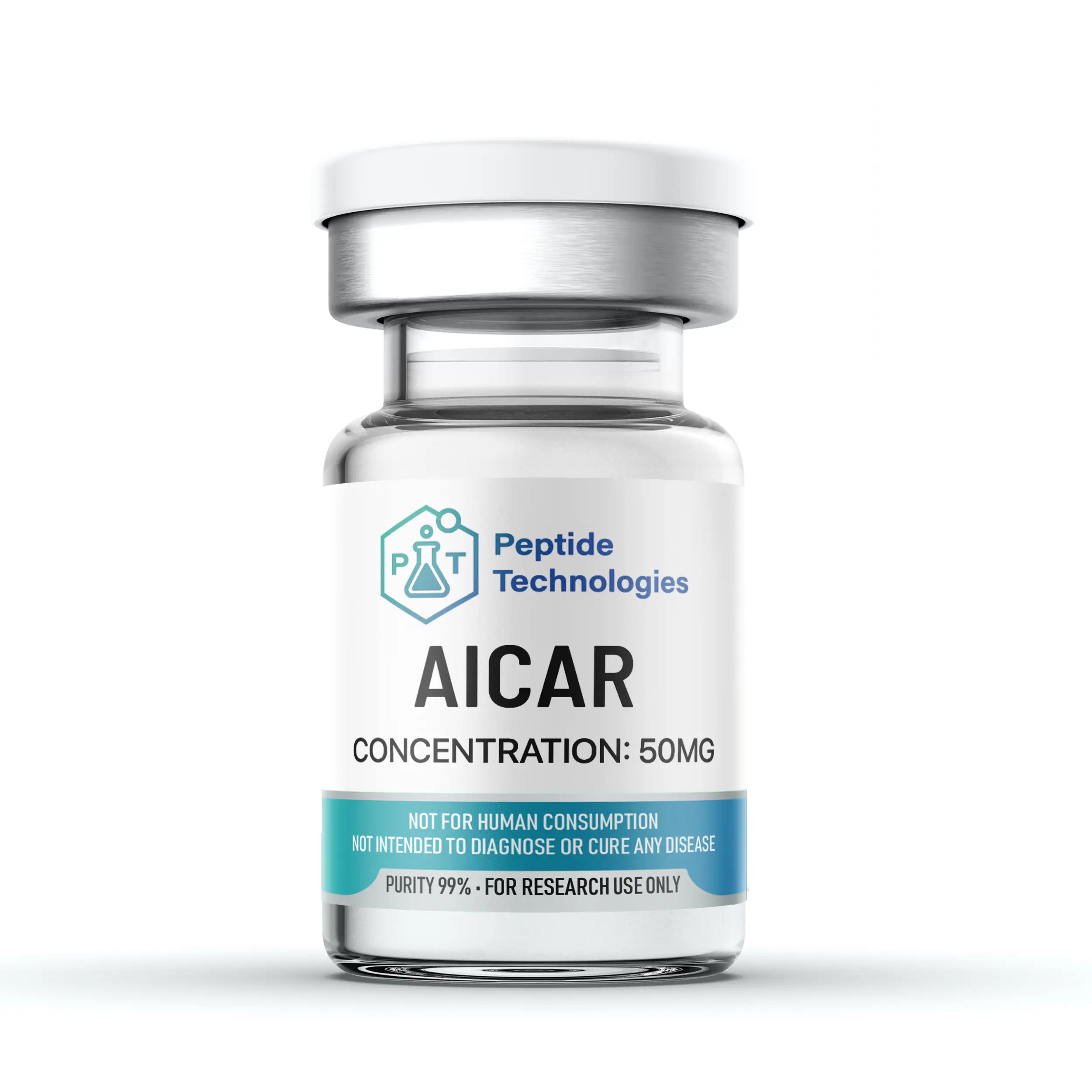



AICAR 50mg
$59.95
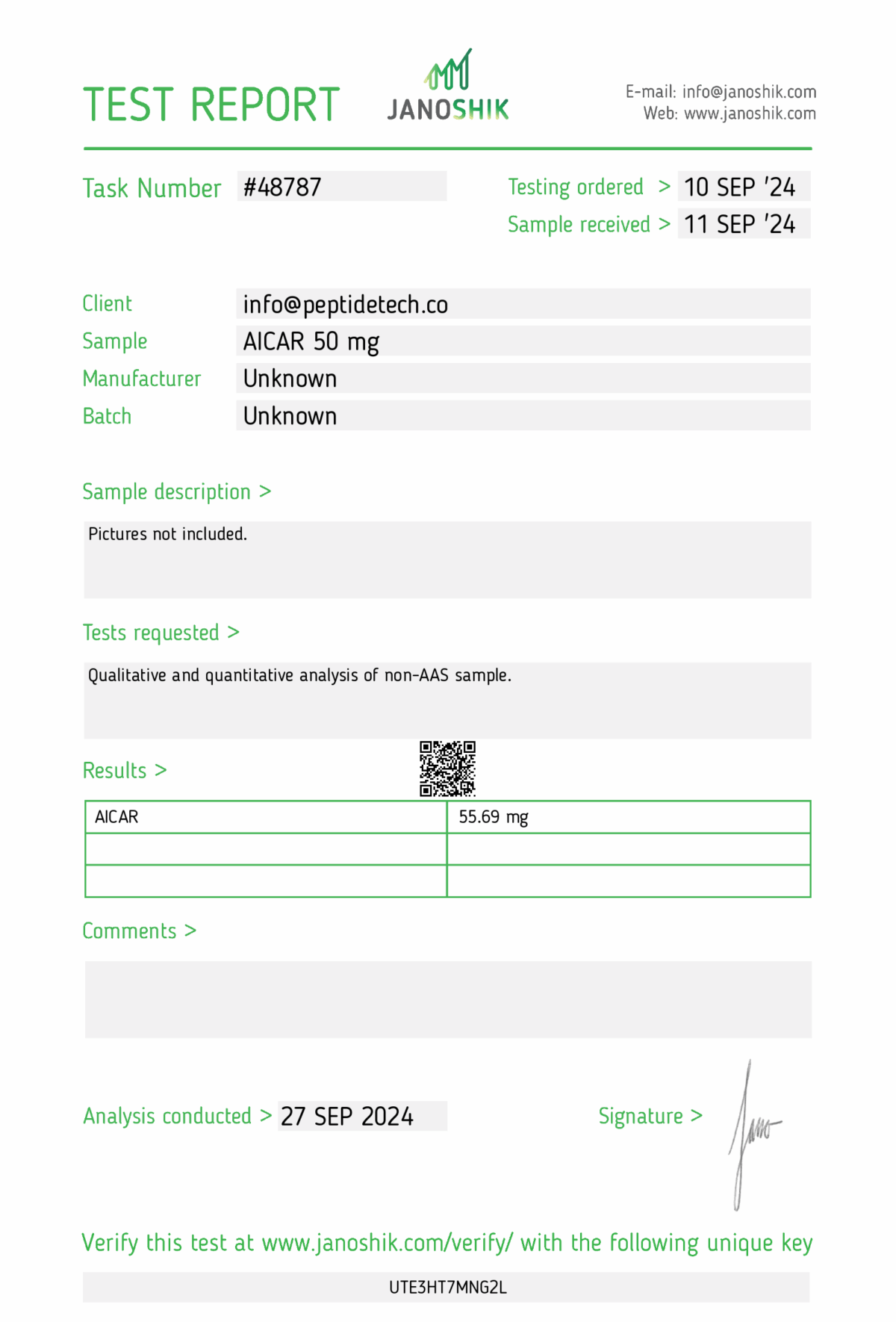
Discover our AICAR 50 mg peptide, ideal for in-vitro and biochemical research. With a purity level of ≥ 99% (HPLC/MS verified), this small-molecule AMP analog helps you probe AMPK signaling and energy metabolism. Explore the potential of AICAR for your research projects today.
Overview
AICAR (Acadesine) 50 mg — also known as 5-aminoimidazole-4-carboxamide ribonucleoside (AICA-riboside) — is a small-molecule AMP analog precursor supplied by
Peptide Tech at ≥ 99% purity (HPLC/MS verified) for in-vitro, cellular, and biochemical research use only (RUO). In cell systems, AICAR is taken up via nucleoside transporters and
phosphorylated to ZMP (AICAR-MP), a bioactive AMP mimetic widely used to probe AMPK signaling, energy homeostasis, and related metabolic pathways under controlled conditions.
Specifications
| Property | Details |
|---|---|
| CAS Number | 2627-69-2 |
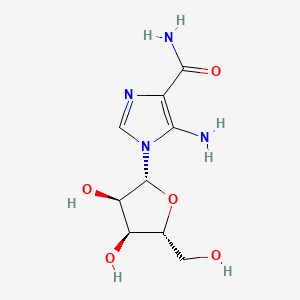
| Chemical Name | 5-Aminoimidazole-4-carboxamide-1-β-D-ribofuranoside (AICAR, Acadesine) |
| PubChem CID | PubChem CID 17513 |
| Molecular Formula | C9H14N4O5 |
| Molecular Weight | ≈ 258.23 g/mol |
| Physical Appearance | White to off-white lyophilized powder |
| Container | 3 mL glass vial (50 mg net content) |
| Purity | ≥ 99% verified by HPLC & MS |
| Solubility | Soluble in water and DMSO; gently invert until fully dissolved; filter-sterilize (0.22 µm) if sterility is required |
Molecular Structure
Storage & Handling
Lyophilized (unopened): Store at ≤ −20 °C in a dry, dark environment. Short-term storage at 2–8 °C is acceptable if the vial remains sealed and will be used soon.
After reconstitution: Prepare sterile aliquots and store at ≤ −20 °C (≤ −80 °C recommended for long-term). Avoid repeated freeze–thaw cycles. Allow vial to reach room temperature before opening to minimize condensation; mix gently—avoid aggressive vortexing.
Potential Applications in Research
Strictly in-vitro/cellular/biochemical contexts — no clinical or human-use claims.
- AMPK pathway activation: Use AICAR to raise intracellular ZMP and activate AMPK for signaling/pathway mapping in cultured cells
(Corton et al., 1995;
JBC overview). - Glucose transport & metabolism assays: Examine AMPK-linked effects on hexose uptake and metabolic readouts in muscle/adipocyte models
(Diabetes 2003;
AJP-Endo 1999). - Autophagy & bioenergetics: Evaluate AICAR’s impact on autophagic flux and energy sensors in hepatocyte or other cell lines
(JBC 1998). - Method controls & off-target assessment: Pair AICAR treatments with genetic AMPK modulation to distinguish AMPK-dependent vs. independent effects in assay design
(Cells 2021 review).
Citations
- Corton, Julia M., John G. Gillespie, Simon A. Hawley, and D. Grahame Hardie. “5-Aminoimidazole-4-Carboxamide Ribonucleoside: A Specific Method for Activating AMP-Activated Protein Kinase in Intact Cells?” European Journal of Biochemistry, vol. 229, no. 2, 1995, pp. 558–565.
PDF - Holman, Geoffrey D., and Harriet Wallberg-Henriksson. “5-Amino-Imidazole Carboxamide Riboside Increases Glucose Transport in Skeletal Muscle via an Insulin-Independent Mechanism.” Diabetes, vol. 52, no. 5, 2003, pp. 1066–1072.
Article - Winder, William W., et al. “Effect of AMPK Activation on Muscle Glucose Metabolism in Conscious Rats.” American Journal of Physiology-Endocrinology and Metabolism, vol. 276, no. 5, 1999, E938–E944.
PDF - Meley, Dominique, et al. “Inhibition of Autophagy by Adenosine, AICAR, or 6-Mercaptopurine Riboside in Isolated Hepatocytes.” Journal of Biological Chemistry, 1998.
Full text - Višnjić, Dora, et al. “AICAr, a Widely Used AMPK Activator with Important AMPK-Independent Effects: A Systematic Review.” Cells, vol. 10, no. 5, 2021, 1095.
Article /
PDF
Compliance & RUO Disclaimer
For laboratory research use only (RUO). Not for human or veterinary use, ingestion, diagnostic, or therapeutic applications.
Purchase and use limited to qualified personnel operating under institutional laboratory guidelines.
Related Products
Browse more in Peptides.
Always read the label and use products as directed. Consult a qualified professional where appropriate.
Related products