

Vesugen 20mg
$39.95
Discover Vesugen 20mg, a premium lyophilized tripeptide (KED) from Peptide Tech Solutions. Packed with ≥99% purity, this research-use-only peptide is ideal for in-vitro studies demanding precise documentation and traceability. Enhance your analytical method-development with Vesugen and experience reliable results in your projects.
Overview
Vesugen 20 mg (Lys–Glu–Asp, “KED”) from Peptide Tech is a premium, lyophilized research-use-only (RUO) tripeptide supplied at ≥99% purity (HPLC & MS verified). This sequence-defined peptide is packaged for reproducible in-vitro endothelial, peptide-transport, and analytical method-development studies where documentation, batch traceability, and cold-chain integrity are essential.
Specifications
| Property | Details |
|---|---|
| Product | Vesugen (KED) — 20 mg lyophilized peptide |
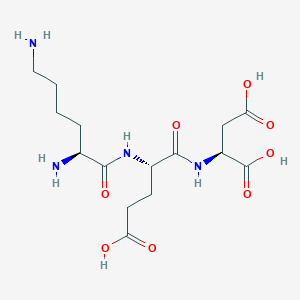
| Chemical Name | H-Lys-Glu-Asp-OH (L-lysyl-L-glutamyl-L-aspartic acid) |
| Synonyms | KED; Lys-Glu-Asp; Vesugen; lysylglutamyl aspartic acid |
| CAS Number | 204271-66-9 (sequence: Lys-Glu-Asp) |
| PubChem CID | 87571363 |
| Sequence | Lys–Glu–Asp (K-E-D) |
| Molecular Formula | C15H26N4O8 |
| Molecular Weight | ≈ 390.39 g/mol |
| Appearance | White to off-white lyophilized powder |
| Content per Vial | 20 mg |
| Container | 3 mL Type I glass vial; butyl stopper; flip-off seal |
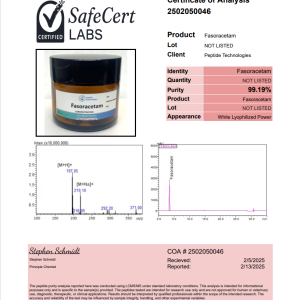
| Purity / Identity | ≥99% by HPLC; identity by MS (batch COA via on-vial QR) |
| Solubility | Soluble in sterile water or neutral aqueous buffers. If your SOP requires, 0.22 µm filter after reconstitution. |
| Storage (lyophilized) | −20 °C long-term (desiccated, light-protected) |
| After Reconstitution | Aliquot; store at ≤ −20 °C (or −80 °C per SOP); avoid repeat freeze–thaw |
| Intended Use | Research Use Only (RUO). Not for human or animal use. |
Molecular Structure
Key Features of Peptide Tech
- Same-Day Shipping (Mon–Fri, on in-stock items)
- GMP-Aligned lyophilization & documentation
- USA-Made peptides
- 24/7 Support & Price Match Guarantee
- Batch QR for instant COA & chain-of-custody verification
- 3rd-Party U.S. Lab Testing — purity, quantity, endotoxin
- Cold-Chain Shipping — Always (no paid upgrade)
- Worldwide Shipping; all major payments accepted
- Text & Email order updates; 2-Day FedEx/UPS standard with low-cost overnight
- Largest Variety of peptides & bioregulators
Potential Applications in Research (RUO)
Strictly for laboratory research. No health, diagnostic, or therapeutic claims.
- Endothelial network formation (2D) — quantify tube-formation metrics (nodes, meshes, total length) in HUVEC/HMEC-1 assays on basement-membrane matrix under defined KED exposures; include vehicle and positive controls.
- Microvessel sprouting (3D) — use human blood-vessel-on-a-chip systems to evaluate VEGF-dependent sprout initiation/elongation and barrier readouts with tripeptide treatment.
- Peptide-transporter profiling — assess PEPT1/PEPT2 uptake in Caco-2 or HEK over-expression systems to map short-peptide transport kinetics and sequence/charge determinants.
- Cell-state panels in neuroendocrine models — measure proliferation (Ki-67), apoptosis markers (e.g., p53 immunostaining/Western), and viability under controlled culture conditions.
- Analytical method development — establish RP-HPLC and LC–MS/MS for identity, purity, recovery, and forced-degradation stability across buffers and temperatures.
Citations (MLA)
- Kvetnoy, I. M., et al. “Effect of Tripeptide Lys–Glu–Asp on Physiological Activity of Neuroimmunoendocrine System Cells.” Bulletin of Experimental Biology and Medicine, vol. 153, no. 4, 2012, pp. 563–566. https://doi.org/10.1007/s10517-012-1768-7
- Pauty, Joris, et al. “A VEGF-Dependent Sprouting Angiogenesis Assay Based on a Human Blood-Vessel-on-a-Chip.” EBioMedicine, vol. 27, 2018, pp. 225–236. Link
- DeCicco-Skinner, Kathleen L., et al. “Assays to Examine Endothelial Cell Migration, Tube Formation, and Gene Expression.” Methods in Molecular Biology, 2014, pp. 255–264. Link
- Brandsch, Matthias. “Drug Transport via the Intestinal Peptide Transporter PepT1.” Drug Discovery Today: Technologies, vol. 9, no. 2, 2012/2013, pp. e7–e14. Link
Quality, Storage & Handling
Every lot is confirmed by HPLC (purity) and MS (identity); the on-vial QR links to the batch COA. Independent U.S. labs verify purity, quantity, and endotoxin.
- Storage (lyophilized): −20 °C long-term or 2–8 °C short-term; keep desiccated and protected from light.
- After reconstitution: Aliquot and store at ≤ −20 °C (or −80 °C per SOP); avoid repeated freeze–thaw cycles.
- Reconstitution tips: Use sterile water or suitable buffer; gently swirl/invert to dissolve. If sterility is required, pass through a 0.22 µm filter and aliquot promptly.
Shipping & Fulfillment
Ships with validated cold-chain packaging. In-stock orders placed before the daily cutoff ship the same day. 2-Day FedEx/UPS is standard, with overnight options available. Automated text/email updates included; international shipping available where permitted.
Compliance & RUO Disclaimer
For laboratory research only. Not a drug, cosmetic, food, or household chemical. Not for human or animal use, ingestion, diagnostic, or therapeutic applications. Buyers warrant they are qualified to handle RUO materials under applicable laws and institutional guidelines.
FAQs
- Is Vesugen the same as Vilon or Thymogen?
- No. Vesugen is the tripeptide Lys–Glu–Asp (KED). Vilon is the dipeptide Lys–Glu (KE), and Thymogen is Glu–Trp (EW). Always verify the exact sequence required by your protocol.
- What purity do you provide?
- Each 20 mg vial is ≥99% by HPLC with MS identity confirmation; third-party testing is performed on every lot (COA via on-vial QR).
- How should I reconstitute it?
- Dissolve in sterile water or a compatible buffer; gently invert until fully dissolved. If your SOP requires sterility, 0.22 µm filter and aliquot to avoid repeat freeze–thaw.
- Which in-vitro assays are common?
- Typical RUO uses include tube-formation/sprouting assays, PEPT1/PEPT2 transport studies, cell-state panels (Ki-67/p53), and HPLC/LC–MS method development (see citations above).
Explore More
Browse additional research peptides and accessories at Peptide Tech.
Related Products
Browse more in Bioregulators.
Always read the label and use products as directed. Consult a qualified professional where appropriate.
Related products