





BPC-157 & TB-500 Blend – 5mg/5mg
$49.95
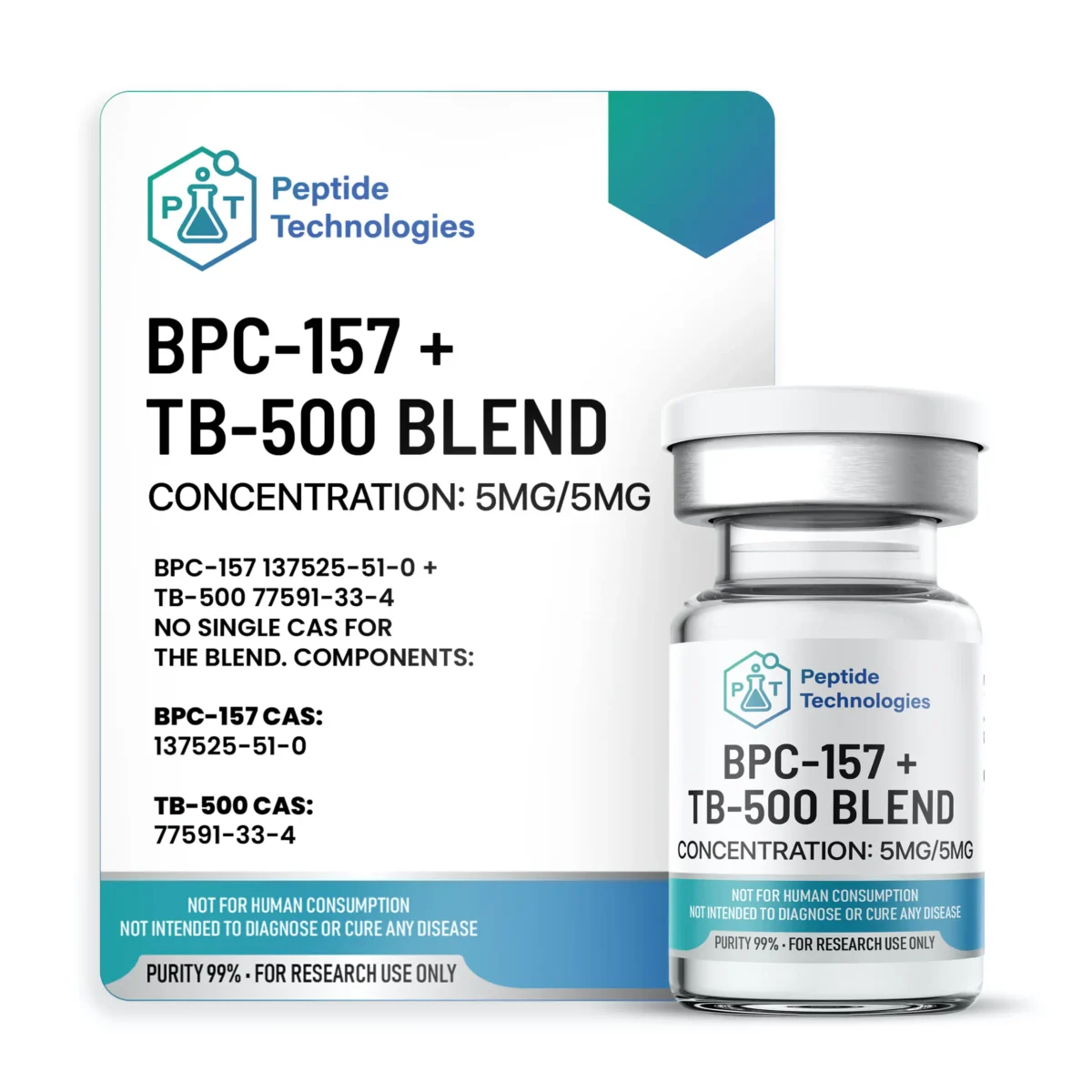
The BPC-157 & TB-500 Blend combines two powerful peptides, BPC-157 (5 mg) and Thymosin β4 (TB-500) (5 mg), to facilitate in-vitro and biochemical studies. With ≥99% purity verified by HPLC/MS, this research-grade product is perfect for assay development and pathway validation in controlled settings. Enhance your research with this reliable reference material today.
BPC-157 & TB-500 Blend — 5 mg / 5 mg pairs two well-characterized research peptides—BPC-157 (GEPPPGKPADDAGLV) and Thymosin β4 (TB-500)—to support multi-pathway in-vitro, cellular, and biochemical studies. Supplied by
Peptide Tech at ≥99% purity (HPLC/MS verified), this RUO reference material is ideal for assay development, method validation, and pathway interrogation under controlled laboratory conditions.
Specifications
| Components | BPC-157 (5 mg) + Thymosin β4 / “TB-500” (5 mg) |
| CAS Numbers | BPC-157: 137525-51-0 · Thymosin β4: 77591-33-4 |
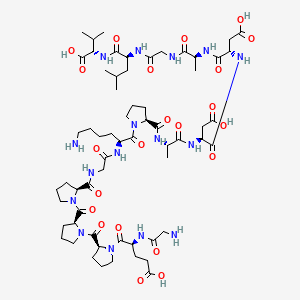
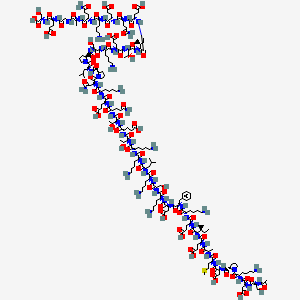
| PubChem CIDs | BPC-157: CID 9941957 · Thymosin β4: CID 16132341 |
| Molecular Formula (approx.) | BPC-157: C62H98N16O22 · Thymosin β4: C212H350N56O78S |
| Molecular Weight (approx.) | BPC-157: ~1419.5 g/mol · Thymosin β4: ~4963 g/mol |
| Sequences | BPC-157: Gly-Glu-Pro-Pro-Pro-Gly-Lys-Pro-Ala-Asp-Asp-Ala-Gly-Leu-Val · Thymosin β4 (43 aa): SDKPDMAEIEKFDKSKLKK TETQEKNPLP SKETIEQEKQ AGES |
| Physical Appearance | White to off-white lyophilized powder |
| Container | 3 mL glass vial (blend, 10 mg net content) |
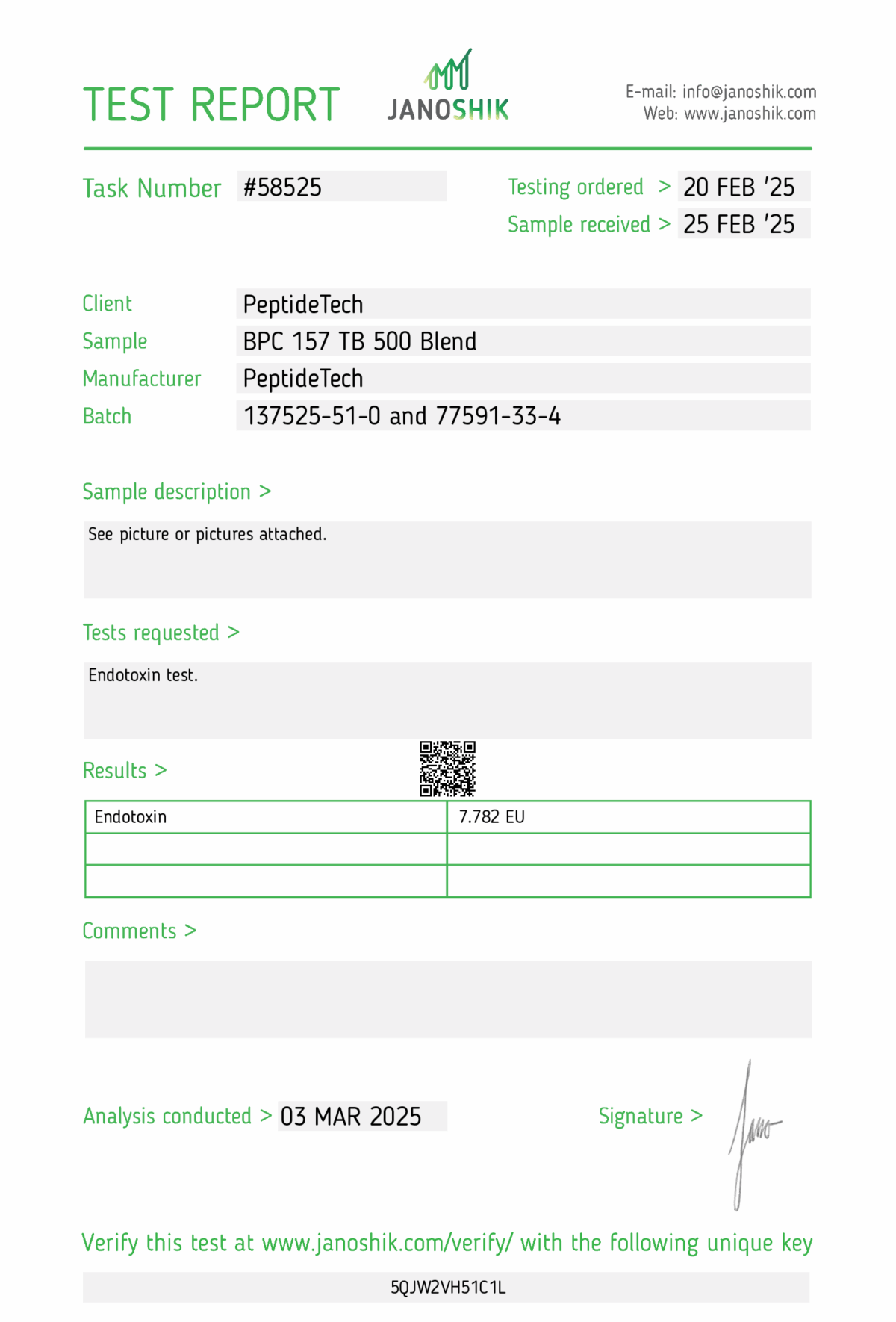
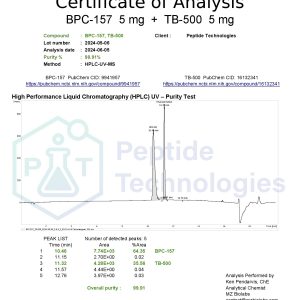
| Purity | ≥99% (HPLC & MS; third-party verified) |
| Solubility | Soluble in sterile water or compatible aqueous buffer; mix gently until fully dissolved; 0.22 µm filter-sterilize if required |
Molecular Structure (PubChem)
Why Peptide Tech
- Same-Day Shipping
- GMP-Aligned Lyophilized Peptides
- USA Made
- 24/7 Support
- Price Match Guarantee
- Batch Tracking with QR Code Verification
- 3rd-Party USA Lab Testing — purity, quantity, endotoxin
- Cold-Chain Shipping — Always (no paid upgrade)
- Worldwide Shipping
- All Major Payments Accepted
- Text & Email Order Updates
- 2-Day FedEx/UPS Shipping Standard
- Cheapest Overnight Rates
- Largest Variety of Peptides & Bioregulators
Storage & Handling
- Lyophilized (unopened): Store at ≤ −20 °C, protected from light and moisture. For long-term archival, ≤ −80 °C is recommended.
- After reconstitution: Prepare sterile aliquots; store at ≤ −80 °C for maximal stability (≤ −20 °C for short-term work). Avoid repeated freeze–thaw cycles.
- Handling notes: Let vials equilibrate to room temperature before opening to minimize condensation. Use sterile water or compatible buffer (e.g., PBS). Do not expose to extreme pH or oxidants.
- Research Use Only (RUO): Not for human or veterinary use, ingestion, diagnostic, or therapeutic applications.
Potential Applications in Research
Strictly in-vitro, cellular, or biochemical contexts; no clinical or human-use claims.
- Cell migration & cytoskeletal remodeling assays (BPC-157): Evaluate fibroblast/tendocyte migration, spreading, F-actin organization, and survival under stress in culture models.
Chang et al., 2011 (J Appl Physiol). - Matrix & tendon model workflows (BPC-157): Use for in-vitro tendocyte growth and method benchmarking alongside tendon-derived ECM readouts.
Staresinic et al., 2003 (J Orthop Res). - Angiogenesis/corneal epithelium pathway assays (TB-500): Probe migration, re-epithelialization markers, and cytokine/NF-κB signaling in ocular epithelial cell systems.
Sosne et al., 2002 (Exp Eye Res);
Sosne et al., 2007 (Exp Eye Res). - Actin-binding/cytoskeletal regulation (TB-500): Explore actin sequestration and downstream effects on motility and repair-associated gene programs in cell lines.
Goldstein et al., 2012 (Expert Opin Biol Ther). - Cross-validation of analytical methods (both peptides): Use verified sequences/CIDs to validate LC-MS/HPLC identity, purity, and stability; apply as controls in peptide analytics.
Sikiric et al., 2011 (Curr Pharm Des). - Tubulogenesis/angiogenic readouts (TB-500): Quantify migration and re-epithelialization endpoints in dermal/epithelial models with standardized image-based metrics.
Malinda et al., 1999 (J Invest Dermatol).
Citations (PubMed)
- Chang, C.-H., Tsai, W.-C., Lin, M.-S., Hsu, Y.-H., Pang, J.-H. S. “The promoting effect of pentadecapeptide BPC 157 on tendon healing involves tendon outgrowth, cell survival, and cell migration.” Journal of Applied Physiology 110(3), 2011, 774–780. PubMed
- Staresinic, M., et al. “Gastric pentadecapeptide BPC 157 accelerates healing of transected rat Achilles tendon and in vitro stimulates tendocytes growth.” Journal of Orthopaedic Research 21(6), 2003, 976–983. PubMed
- Malinda, K. M., et al. “Thymosin β4 accelerates wound healing.” Journal of Investigative Dermatology 113(2), 1999, 364–368. PubMed
- Sosne, G., et al. “Thymosin β4 promotes corneal wound healing and decreases inflammation in vivo following alkali injury.” Experimental Eye Research 74(2), 2002, 293–299. PubMed
- Sosne, G., et al. “Thymosin beta 4 suppression of corneal NF-κB: a potential anti-inflammatory pathway.” Experimental Eye Research 84(4), 2007, 663–669. PubMed
- Goldstein, A. L., Hannappel, E., Sosne, G., Kleinman, H. K. “Thymosin β4: a multi-functional regenerative peptide—basic properties and clinical applications.” Expert Opinion on Biological Therapy 12(1), 2012, 37–51. PubMed
- Šikić, P., et al. “Stable gastric pentadecapeptide BPC 157: novel therapy in gastrointestinal tract.” Current Pharmaceutical Design 17(16), 2011, 1612–1632. PubMed
Compliance & RUO Disclaimer
For laboratory research use only (RUO). Not for human or veterinary use, ingestion, diagnostic, or therapeutic applications. Use is limited to qualified professionals in controlled laboratory settings.
Related Products
Browse more in Peptides.
Always read the label and use products as directed. Consult a qualified professional where appropriate.
Related products