

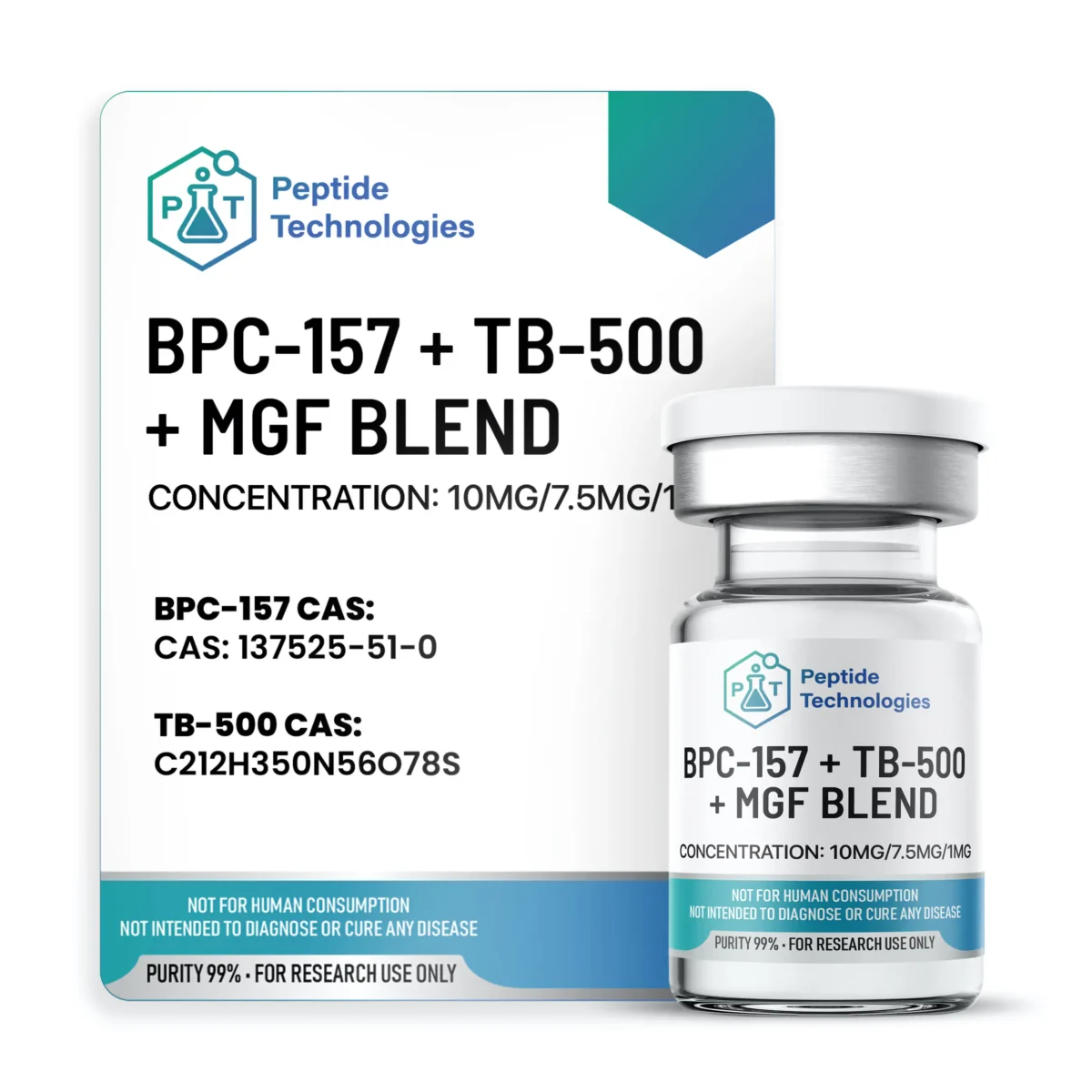


BPC-157, TB-500 & MGF Blend – 10mg/7.5mg/1mg
$99.99
Explore the BPC-157, TB-500 & MGF Blend from Peptide Tech Solutions, featuring 10 mg of BPC-157, 7.5 mg of TB-500, and 1 mg of MGF in a single vial. Perfect for laboratory research, this blend is lyophilized for easy use. Each component is produced under GMP-aligned standards, ensuring high quality and traceability.
BPC-157, TB-500 & MGF Blend — 10 mg / 7.5 mg / 1 mg (Lyophilized, RUO)
BPC-157, TB-500 & MGF Blend from Peptide Tech combines three widely studied research peptides in a single, lyophilized format for streamlined laboratory work. Each vial contains 10 mg BPC-157, 7.5 mg TB-500 (thymosin β4), and 1 mg MGF (IGF-1 Ec E-peptide). Produced under GMP-aligned procedures with batch-level traceability and QR-linked COA access, this blend is intended strictly for laboratory research use only (RUO)—ideal for in-vitro, cell-based, and analytical workflows where identity, purity, and handling consistency are essential.
Specifications
| Property | Details |
|---|---|
| Product Name | BPC-157, TB-500 & MGF Blend — 10 mg / 7.5 mg / 1 mg |
| Form | Lyophilized powder (freeze-dried) |
| Container | Sterile Type I glass vial (research-grade closure); QR batch ID |
| Appearance | White to off-white lyophilized cake/powder |
| Composition (per vial) | BPC-157 (10 mg); TB-500/thymosin β4 (7.5 mg); MGF/IGF-1 Ec E-peptide (1 mg) |
| Purity / ID | Research-grade; identity & purity confirmed per lot (e.g., MS/HPLC); see COA |
| Intended Use | For laboratory research only (RUO); not for human or animal use, ingestion, diagnostic, therapeutic, or veterinary applications |
| Solubility (general) | Reconstitute with sterile water or compatible buffer; optimize pH/ionic strength per assay; filter (0.22 µm) if your protocol requires sterility |
| Storage | Store sealed, desiccated, and protected from light. Short-term: 2–8 °C. Long-term: ≤−20 °C. Avoid repeated freeze–thaw after reconstitution. |
Component References & Identifiers
- BPC-157 — CAS: 137525-51-0; Sequence: GEPPPGKPADDAGLV; Formula: C62H98N16O22; ~1419.5 g/mol; PubChem CID 9941957
- TB-500 (thymosin β4) — CAS: 77591-33-4 (human Tβ4); 43 aa peptide; commonly referenced as timbetasin; PubChem CID 16132341 • structure/sequence resources: UniProt P62328
- MGF (IGF-1 Ec E-peptide) — splice-variant E-peptide derived from IGF-1 (Ec isoform); identifiers vary by construct; CAS not universally assigned; reference protein: UniProt P05019 (IGF-1)
Molecular Structure
For visual reference, link to public structures/records
- BPC-157
- TB-500 / timbetasin • UniProt
- IGF-1 (MGF context)
Key Features — Peptide Tech
- Same-Day Shipping (Mon–Fri, in-stock)
- GMP-Aligned lyophilization & packaging
- USA Made with QR COA access
- Third-Party USA Lab Testing — purity, quantity; endotoxin where applicable
- Cold-Chain Shipping — Always (no paid upgrade)
- Worldwide Shipping with compliant documentation
- All Major Payments, text/email updates, and 2-Day FedEx/UPS standard
Potential Applications in Research
Examples below are strictly in-vitro, cell-based, or biochemical contexts; no health or therapeutic claims are made.
- Endothelial tube-formation & migration assays (e.g., HUVEC) to profile angiogenesis-related signaling with BPC-157 or thymosin β4 under controlled conditions.
- Actin dynamics / sequestration workflows (fluorescence-based polymerization, sedimentation) to examine thymosin β4 interactions with G-actin and effects on cytoskeletal remodeling.
- Scratch/transwell cell-migration models in fibroblasts or endothelial lines to quantify motility changes in response to peptide exposure.
- Myoblast proliferation/differentiation assays investigating IGF-1 Ec (MGF) E-peptide signaling versus mature IGF-1 using Erk/Akt readouts and myogenic markers.
- Analytical method development (HPLC/LC-MS/MS) for multi-analyte blends: identity, assay, degradation profiling, and matrix effects.
Citations (MLA; supports the “Potential Applications” section)
- Hsieh, Ming-Jer, et al. “Therapeutic Potential of Pro-Angiogenic BPC157 Is Associated with VEGFR2 Activation and Up-Regulation.” Journal of Molecular Medicine, vol. 95, no. 3, 2017, pp. 323–333. DOI: 10.1007/s00109-016-1488-y. Link.
- Malinda, K. M., et al. “Thymosin Beta 4 Stimulates Directional Migration of Human Umbilical Vein Endothelial Cells.” FASEB Journal, vol. 11, no. 6, 1997, pp. 474–481. DOI: 10.1096/fasebj.11.6.9194528. Link.
- Safer, D., et al. “Thymosin Beta 4 Binds Actin in an Extended Conformation and Contacts Both the Barbed and Pointed Ends.” Biochemistry, vol. 36, no. 19, 1997, pp. 5806–5816. DOI: 10.1021/bi970185v. Link.
- Yang, Shou-Ying, and Geoffrey Goldspink. “Different Roles of the IGF-I Ec Peptide (MGF) and Mature IGF-I in Myoblast Proliferation and Differentiation.” FEBS Letters, vol. 522, 2002, pp. 156–160. DOI: 10.1016/S0014-5793(02)02991-1. Link.
Quality, Storage & Handling
- Quality: Each lot is confirmed by MS/HPLC (see COA). Third-party testing performed in the U.S. where applicable.
- Reconstitution: Bring vial to room temperature; add sterile solvent; swirl gently to dissolve; aliquot promptly. Avoid vigorous agitation/foaming.
- After Reconstitution: Store aliquots at ≤−20 °C; avoid multiple freeze–thaw cycles.
Shipping & Fulfillment
Ships with validated cold-chain packaging. In-stock orders placed before the daily cutoff dispatch the same day. 2-Day FedEx/UPS is standard, with overnight options available. Automated text/email updates included; international service available where permitted.
Compliance & RUO Disclaimer
For laboratory research use only. Not a drug, food, or cosmetic. Not for human or animal use, ingestion, diagnostic, therapeutic, or veterinary applications. Purchasers must be qualified to handle RUO materials and comply with applicable laws and institutional policies.
FAQs
- Are exact sequences provided?
- Sequences for BPC-157 and thymosin β4 are well established. MGF is an IGF-1 splice-variant E-peptide; specific construct details are listed on the lot COA.
- What solvent should I start with?
- Begin with sterile water or a neutral buffer. Adjust pH/ionic strength per your assay and confirm recovery; filter (0.22 µm) if your protocol requires sterility.
- Can I get the COA?
- Yes. Scan the vial’s QR code or contact support to access batch-specific documentation (identity, purity, and testing notes).
Related Products
Browse more in Peptides.
Always read the label and use products as directed. Consult a qualified professional where appropriate.
Related products