$69.95
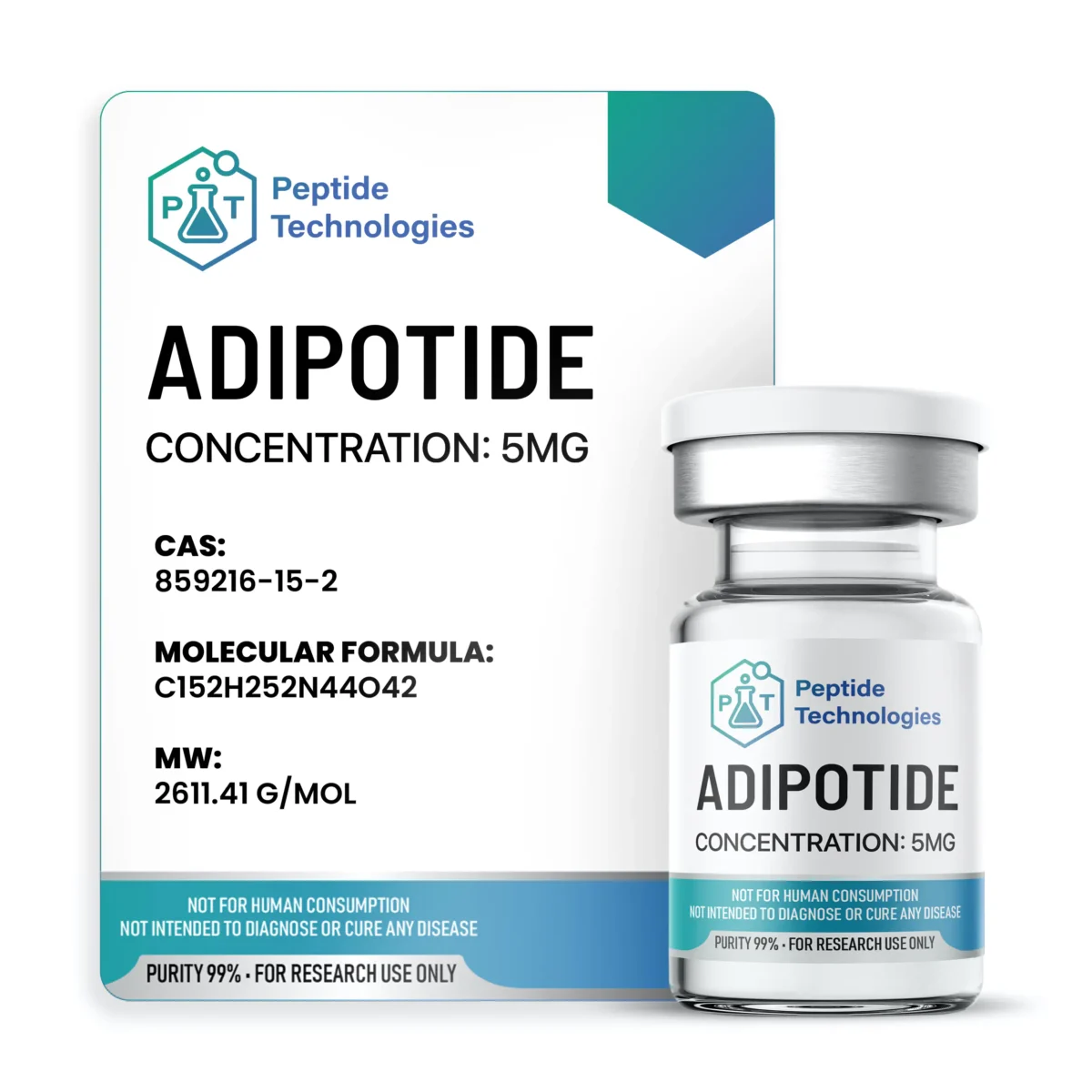
Adipotide (FTPP / Prohibitin-TP01) 5 mg is a chimeric, white-adipose-vasculature–targeted peptidomimetic supplied by Peptide Tech at ≥ 99% purity (HPLC/MS verified) for in-vitro, cellular, and biochemical research use only (RUO). The 25-mer combines a WAT-homing motif (CKGGRAKDC), a flexible GG linker, and a D-amino-acid pro-apoptotic domain D(KLAKLAK)2, enabling interrogation of prohibitin/ANXA2-associated pathways and mitochondrial membrane responses under controlled laboratory conditions.
Specifications
| Property | Details |
|---|---|
| CAS Number | 859216-15-2 |
| Chemical Name | Adipotide; Prohibitin-Targeting Peptide-1 (Prohibitin-TP01) |
| Synonyms | FTPP; Fat-Targeted Pro-Apoptotic Peptide |
| PubChem CID | PubChem CID 16143998 |
| Sequence | CKGGRAKDC-GG-D(KLAKLAK)2 |
| Molecular Weight | ~2.5–2.6 kDa (varies by salt form) |
| Physical Appearance | White to off-white lyophilized powder |
| Container | 3 mL glass vial (5 mg net content) |
| Purity | ≥ 99% verified by HPLC & MS |
| Solubility | Soluble in sterile water or compatible aqueous buffer; gently invert until dissolved; filter-sterilize (0.22 µm) if your application requires sterility |
Molecular Structure

Storage & Handling
Lyophilized (unopened): Store at ≤ −20 °C in a dry, dark environment. Short-term storage at 2–8 °C is acceptable if the vial remains sealed and will be used imminently.
After reconstitution: Prepare sterile aliquots; store at ≤ −20 °C (≤ −80 °C recommended for long term). Avoid repeated freeze–thaw cycles.
Let the vial reach room temperature before opening; mix gently—avoid aggressive vortexing.
Potential Applications in Research
Strictly in-vitro, cellular, or biochemical contexts — no clinical or human-use claims.
- Receptor-signaling assays (PHB/ANXA2): Map binding/uptake and downstream signaling in endothelial or adipocyte cultures; use co-IP, colocalization, and reporter readouts.
- WAT-homing motif validation: Evaluate CKGGRAKDC-mediated targeting in cell-based systems (competition/internalization kinetics, live-cell imaging/flow).
- Mitochondrial membrane assays: Probe D(KLAKLAK)2–driven depolarization (e.g., JC-1/TMRE), cytochrome-c release, and viability in vitro.
- Endothelial–adipocyte co-culture models: Study lipid-transport biology (PHB/ANXA2/CD36 complexes) and pathway perturbation with quantitative endpoints.
- Peptidomimetic design benchmarking: Compare linkers or targeting motifs against the CKGGRAKDC-GG-D(KLAKLAK)2 architecture for uptake and in-cell efficacy.
Citations
- Kolonin, Mikhail G., et al. “Reversal of Obesity by Targeted Ablation of Adipose Tissue.” Nature Medicine, vol. 10, no. 6, 2004, pp. 625–632.
PDF - Barnhart, Kimberly F., et al. “A Peptidomimetic Targeting White Fat Causes Weight Loss and Improved Insulin Resistance in Obese Monkeys.”
Science Translational Medicine, vol. 3, no. 108, 2011, 108ra112.
PDF - Salameh, Ahmad, et al. “Prohibitin/Annexin 2 Interaction Regulates Fatty Acid Transport in Adipose Tissue.” JCI Insight, vol. 1, no. 10, 2016, e86351.
Article /
PDF - Ellerby, H. Michael, et al. “Anti-Cancer Activity of Targeted Pro-Apoptotic Peptides.” Nature Medicine, vol. 5, no. 9, 1999, pp. 1032–1038.
DOI - Delgado, J. M., et al. “A Proapoptotic Peptide for the Treatment of Solid Tumors.” Cancer Research, vol. 61, no. 21, 2001, pp. 7709–7712.
Article
Compliance & RUO Disclaimer
For laboratory research use only (RUO). Not for human or veterinary use, ingestion, diagnostic, or therapeutic applications.
Purchase and use limited to qualified personnel operating under institutional laboratory guidelines.
Related products