$44.95
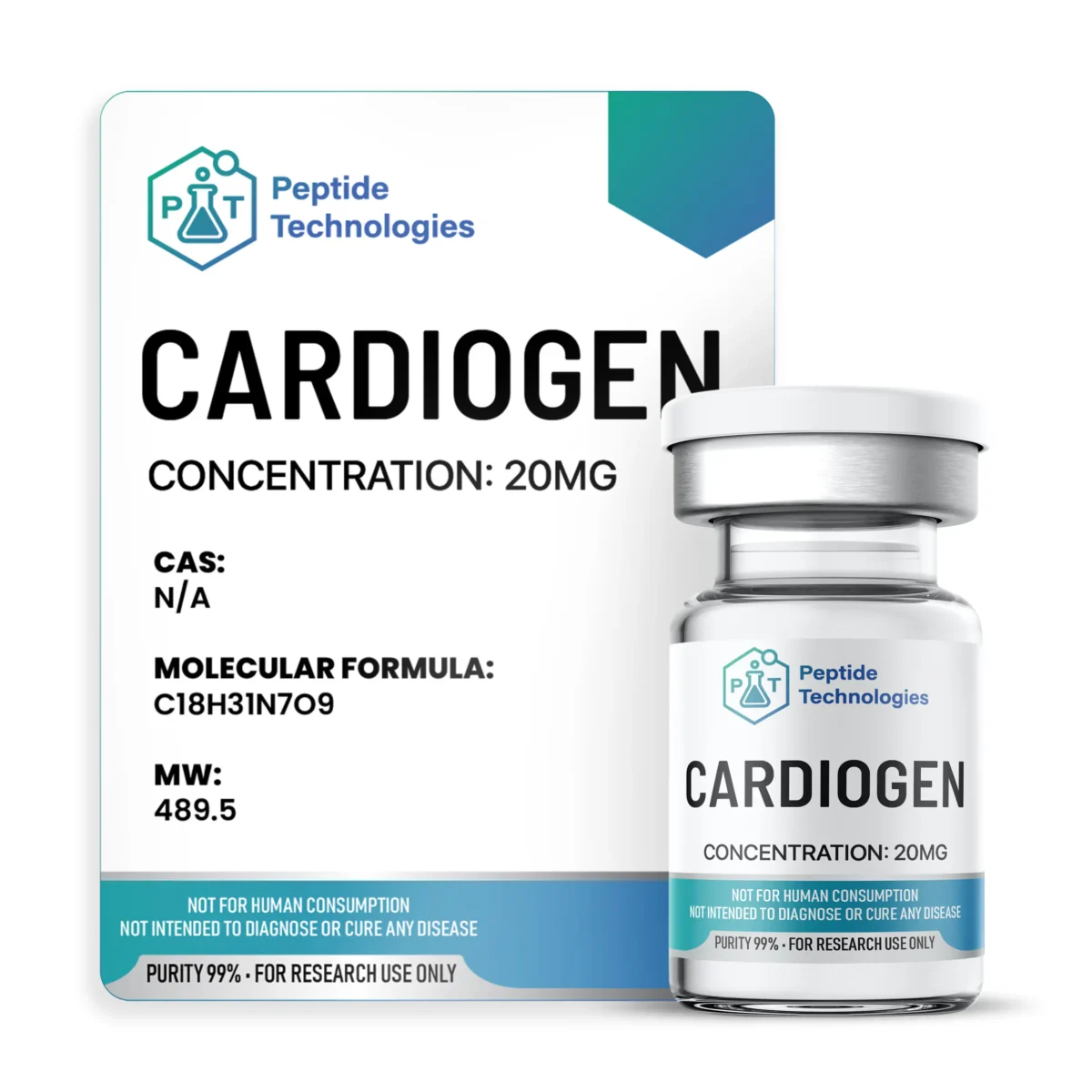
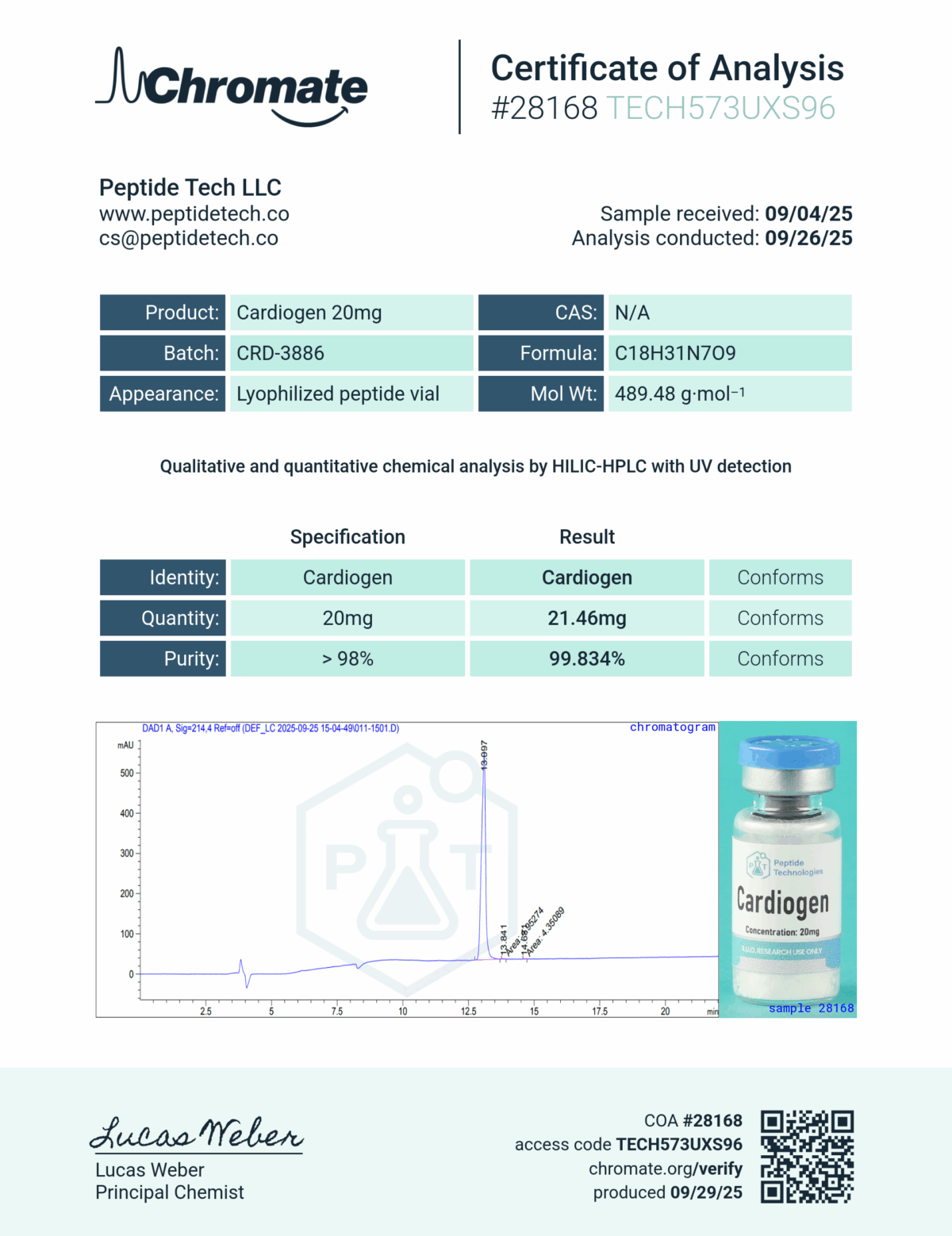
Cardiogen (AEDR) 20 mg from Peptide Tech is a premium, lyophilized research-use-only (RUO) tetrapeptide supplied at ≥99% purity (HPLC & MS verified). The sequence H-Ala-Glu-Asp-Arg-OH (1-letter: A-E-D-R) is widely explored for in-vitro studies involving fibroblast biology, cardiomyocyte cell models, and peptide analytics—where sequence fidelity, documentation, and cold-chain integrity are essential.
Specifications
| Property | Details |
|---|---|
| Product | Cardiogen (AEDR) — 20 mg |
| Chemical Name | H-Ala-Glu-Asp-Arg-OH (free acid) |
| Synonyms | AEDR tetrapeptide; “Cardiogen” |
| CAS Number | Not assigned / varies by registrant (verify per lot COA) |
| PubChem CID | 11583989 |
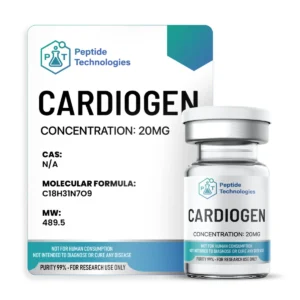
| Molecular Formula | C18H31N7O9 |
| Molecular Weight | ≈ 489.5 g/mol |
| Sequence | Ala–Glu–Asp–Arg (A-E-D-R) |
| Physical Appearance | White to off-white lyophilized powder |
| Container | 3 mL Type I glass vial (20 mg net content) |
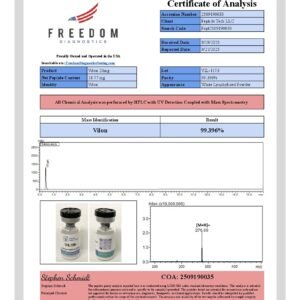
| Purity / ID | ≥99% by HPLC; identity by MS (batch COA via on-vial QR) |
| Solubility | Soluble in sterile water or neutral aqueous buffers; prepare fresh. If required by your SOP, 0.22 µm filter after reconstitution. |
| Intended Use | Laboratory research only (RUO). Not for human or animal use. |
Molecular Structure

View on PubChem (CID 11583989)
Key Features of Peptide Tech
- Same-Day Shipping (Mon–Fri, on in-stock items)
- GMP-Aligned Lyophilized Peptides
- USA Made
- 24/7 Support
- Price Match Guarantee
- Batch Tracking with QR Code Verification
- 3rd-Party U.S. Lab Testing — purity, quantity, endotoxin
- Cold-Chain Shipping — Always (no paid upgrade)
- Worldwide Shipping
- All Major Payments Accepted
- Text & Email Order Updates
- 2-Day FedEx/UPS Standard with low-cost overnight
- Largest Variety of Peptides & Bioregulators
Potential Applications in Research
Strictly for in-vitro, cell-based, or biochemical experiments. No health, diagnostic, or therapeutic claims.
- Fibroblast signaling & cytoskeletal protein expression — quantify actin, tubulin, vimentin, and lamin A/C responses to AEDR in cultured fibroblasts (e.g., immunoblot/IF), building on reports of tetrapeptide-driven protein synthesis changes. :contentReference[oaicite:0]{index=0}
- Cardiomyocyte stress-response panels — assess viability, caspase activity, and apoptosis-related markers (e.g., p53 axis) under controlled stressors (hypoxia/reoxygenation, oxidative challenge) in neonatal/hiPSC-derived cardiomyocytes. :contentReference[oaicite:1]{index=1}
- SASP / inflammaging readouts in vascular cells — profile cytokines and SASP factors (ELISA/RT-qPCR) in endothelial or smooth-muscle models to map short-peptide effects on aging-linked signaling. :contentReference[oaicite:2]{index=2}
- Ligand-free peptide analytics — develop RP-HPLC and LC–MS/MS methods for identity, purity, recovery, and forced-degradation stability in relevant buffers and temperatures.
- Cross-lineage cell models — explore AEDR responses in non-cardiac cell systems (e.g., neuron-like cells) to evaluate generalizable stress-marker modulation and viability metrics. :contentReference[oaicite:3]{index=3}
Citations (MLA)
- Khavinson, V. Kh., et al. “Tetrapeptide H-Ala-Glu-Asp-Arg-OH Stimulates Expression of Cytoskeletal and Nuclear Matrix Proteins.” Bulletin of Experimental Biology and Medicine, vol. 153, no. 4, 2012, pp. 559–562. https://doi.org/10.1007/s10517-012-1766-9. :contentReference[oaicite:4]{index=4}
- Menshchikova, E. B., et al. “Senescence-Associated Secretory Phenotype of Cardiovascular System: Emerging Targets.” Cells, vol. 12, no. 1, 2023, article 106. https://doi.org/10.3390/cells12010106. :contentReference[oaicite:5]{index=5}
- Jevtic, M., et al. “Short Peptides Protect Fibroblast-Derived Induced Neurons from Age-Associated Changes.” International Journal of Molecular Sciences, vol. 25, no. 21, 2024, article 11363. https://doi.org/10.3390/ijms252111363. :contentReference[oaicite:6]{index=6}
Quality, Storage & Handling
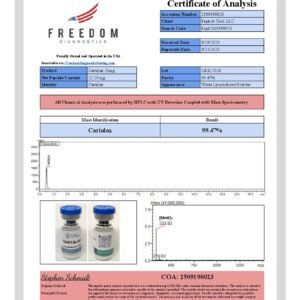
Each lot is confirmed by HPLC (purity) and MS (identity); the on-vial QR links to batch COA. Independent U.S. labs verify purity, quantity, and endotoxin.
- Storage (lyophilized): −20 °C long-term or 2–8 °C short-term; store desiccated and protect from light.
- After reconstitution: Aliquot and store at ≤ −20 °C (or −80 °C per SOP); avoid repeated freeze–thaw cycles.
- Reconstitution tips: Use sterile water or compatible buffer; gently swirl to dissolve. If sterility is required, pass through a 0.22 µm filter and aliquot promptly.
Shipping & Fulfillment
Ships with validated cold-chain packaging. In-stock orders placed before the daily cutoff ship the same day. 2-Day FedEx/UPS is standard, with overnight options available. Automated text/email updates included; international shipping available where permitted.
Compliance & RUO Disclaimer
For laboratory research only. Not a drug, cosmetic, food, or household chemical. Not for human or animal use, ingestion, diagnostic, or therapeutic applications. Buyers warrant they are qualified to handle RUO materials under applicable laws and institutional guidelines.
FAQs
- What is the exact sequence and form?
- H-Ala-Glu-Asp-Arg-OH (A-E-D-R), free-acid C-terminus. See the lot COA for salt form and identifiers.
- Do you provide documentation?
- Yes—every vial includes a QR-linked COA with HPLC/MS data, along with third-party testing for purity, quantity, and endotoxin.
- How should I reconstitute?
- Use sterile water or a neutral buffer. Gently invert or swirl. If your SOP requires sterility, 0.22 µm filter after dissolution and aliquot to avoid freeze–thaw cycles.
- Is Cardiogen intended for human or veterinary use?
- No. This product is sold strictly as RUO and must not be used in humans or animals.
Explore More
Browse additional research peptides and accessories at Peptide Tech.
Related products