


Aniracetam (powder) – 50g
$34.95
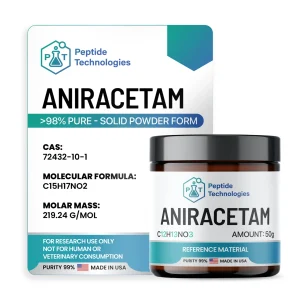
Discover Aniracetam powder (50g) from Peptide Tech Solutions. This pyrrolidinone racetam is known for its role as a positive allosteric modulator for AMPA-type glutamate receptors. Supplied in a glass jar at ≥ 99% purity (HPLC/MS verified), it’s perfect for in-vitro, cellular, and biochemical research use. Please note, this product is not for human or veterinary use.
Aniracetam — 50 g (powder, glass jar)
1-(4-Methoxybenzoyl)pyrrolidin-2-one (Aniracetam) — a pyrrolidinone racetam used widely as a reference positive allosteric modulator (PAM) for AMPA-type ionotropic glutamate receptors in in-vitro electrophysiology and receptor-kinetics research. Supplied by Peptide Tech at ≥ 99% purity (HPLC/MS verified) for in-vitro, cellular, and biochemical research use only (RUO). Not for human or veterinary use.
Specifications
| CAS Number | 72432-10-1 |
| Chemical Name | 1-(4-Methoxybenzoyl)pyrrolidin-2-one (Aniracetam) |
| PubChem CID | 2196 |
| Molecular Formula | C12H13NO3 |
| Molecular Weight | 219.24 g/mol |
| Sequence | N/A (small-molecule; not a peptide) |
| Physical Appearance | White to off-white crystalline powder |
| Container | Type I amber glass jar (net content: 50 g) |
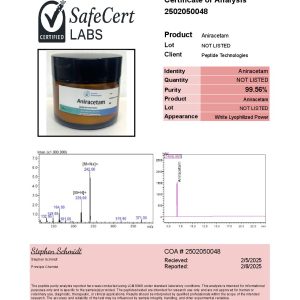
| Purity | ≥ 99% (verified by HPLC & MS; third-party tested) |
| Solubility | Water: insoluble. DMSO: up to ~44 mg/mL. Ethanol: ~11–18 mg/mL. Prepare concentrated DMSO or ethanol stocks, then dilute into final assay buffer with mixing; filter (0.22 µm) if needed for clarity. |
Molecular Structure (Reference)
Why Peptide Tech
- Same-Day Shipping
- GMP-Aligned Lyophilized Peptides
- USA Made
- 24/7 Support
- Price Match Guarantee
- Batch Tracking with QR Code Verification
- 3rd-Party USA Lab Testing — purity, quantity, endotoxin
- Cold-Chain Shipping — Always (no paid upgrade)
- Worldwide Shipping
- All Major Payments Accepted
- Text & Email Order Updates
- 2-Day FedEx/UPS Shipping Standard
- Cheapest Overnight Rates
- Largest Variety of Peptides & Bioregulators
Storage & Handling
- Solid (unopened): Store sealed at 2–8 °C, protected from light and moisture. For long-term archival, ≤ −20 °C is recommended.
- Solutions: Aliquot DMSO/EtOH stocks into low-binding tubes; store at ≤ −20 °C. Avoid repeated freeze–thaw cycles.
- Handling: Allow container to equilibrate to room temperature before opening to minimize condensation. Reseal promptly; consider inert-gas backfill if frequently accessed.
- Research Use Only (RUO): Not for human or veterinary use, ingestion, diagnostic, or therapeutic applications.
Potential Applications in Research
Strictly in-vitro, cellular, or biochemical contexts — no clinical or human-use claims.
- AMPA receptor pharmacology: quantify PAM-dependent effects on deactivation and desensitization by whole-cell or outside-out patch clamp.
- Receptor isoform studies: compare flip/flop splice variants and site-directed mutants for sensitivity to racetam-class modulators.
- Synaptic physiology: examine effects on fast excitatory postsynaptic current (EPSC) decay and short-term plasticity in neurons or brain slices.
- Ligand benchmarking: use as a reference modulator alongside cyclothiazide, CX-series, and other AMPAR PAMs.
- Structure–activity relationship (SAR): evaluate racetam/ampakine analog panels against AMPAR gating kinetics.
- Computational docking/modeling of AMPAR ligand-binding domain (LBD) interfaces with PAMs.
Citations (PubMed)
- Isaacson, J. S., & Nicoll, R. A. “Aniracetam reduces glutamate receptor desensitization and slows the decay of fast excitatory synaptic currents in the hippocampus.” Proc Natl Acad Sci USA, 1991. PubMed
- Partin, K. M., Fleck, M. W., & Mayer, M. L. “AMPA receptor flip/flop mutants affecting deactivation, desensitization, and modulation by cyclothiazide, aniracetam, and thiocyanate.” J Neurosci, 1996. PubMed
- Lawrence, J. J., Brenowitz, S., & Trussell, L. O. “The mechanism of action of aniracetam at synaptic AMPA receptors: indirect and direct effects on desensitization.” Mol Pharmacol, 2003. PubMed
- Jin, R., et al. “Mechanism of positive allosteric modulators acting on AMPA receptors.” Proc Natl Acad Sci USA, 2005. PMC
Compliance & RUO Disclaimer
For laboratory research use only (RUO). Not a drug, food, or cosmetic. Not for human or veterinary use. Purchase and use are limited to qualified personnel operating under institutional laboratory guidelines.
Related Products
- Fasoracetam (powder) – 1g
- Noopept (powder) – 10g
- Phenibut FAA (powder) – 50g
- Phenibut HCL (powder) – 50g
Browse more in Powders.
Always read the label and use products as directed. Consult a qualified professional where appropriate.
Related products