New
$39.99
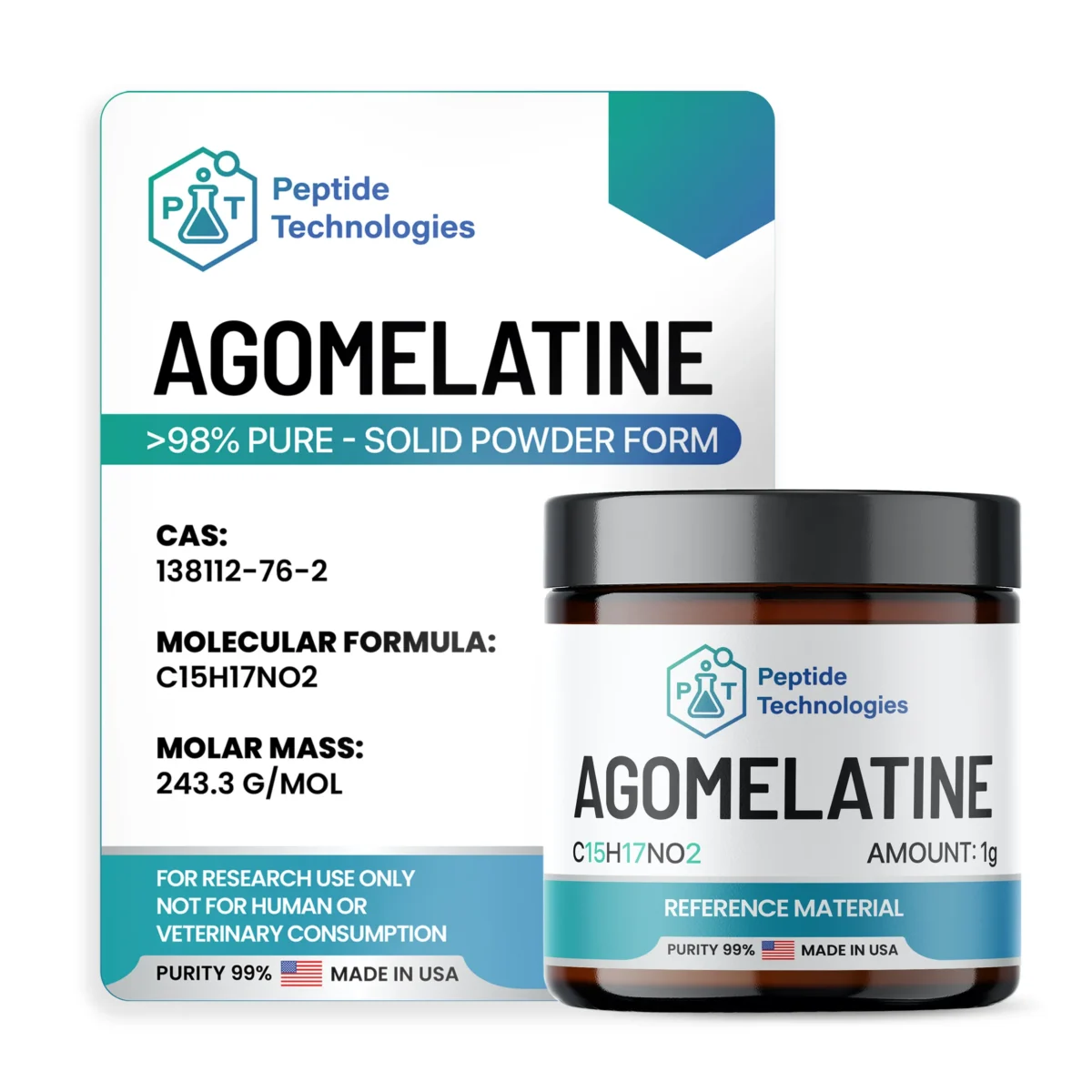
Agomelatine — 1 g (powder, glass jar)
N-[2-(7-methoxynaphthalen-1-yl)ethyl]acetamide (Agomelatine) — a naphthalene acetamide derivative used as a reference ligand for in-vitro melatonin receptor (MT1/MT2) pharmacology and 5-HT2C antagonist assays. Supplied by Peptide Tech at ≥ 99% purity (HPLC/MS verified) for in-vitro, cellular, and biochemical research use only (RUO). Not for human or veterinary use.
Specifications
| CAS Number | 138112-76-2 |
| Chemical Name | N-[2-(7-methoxynaphthalen-1-yl)ethyl]acetamide (Agomelatine) |
| PubChem CID | 82148 |
| Molecular Formula | C15H17NO2 |
| Molecular Weight | 243.30 g/mol |
| Sequence | N/A (small-molecule; not a peptide) |
| Physical Appearance | White to off-white crystalline powder |
| Container | Type I amber glass jar (net content: 1 g) |
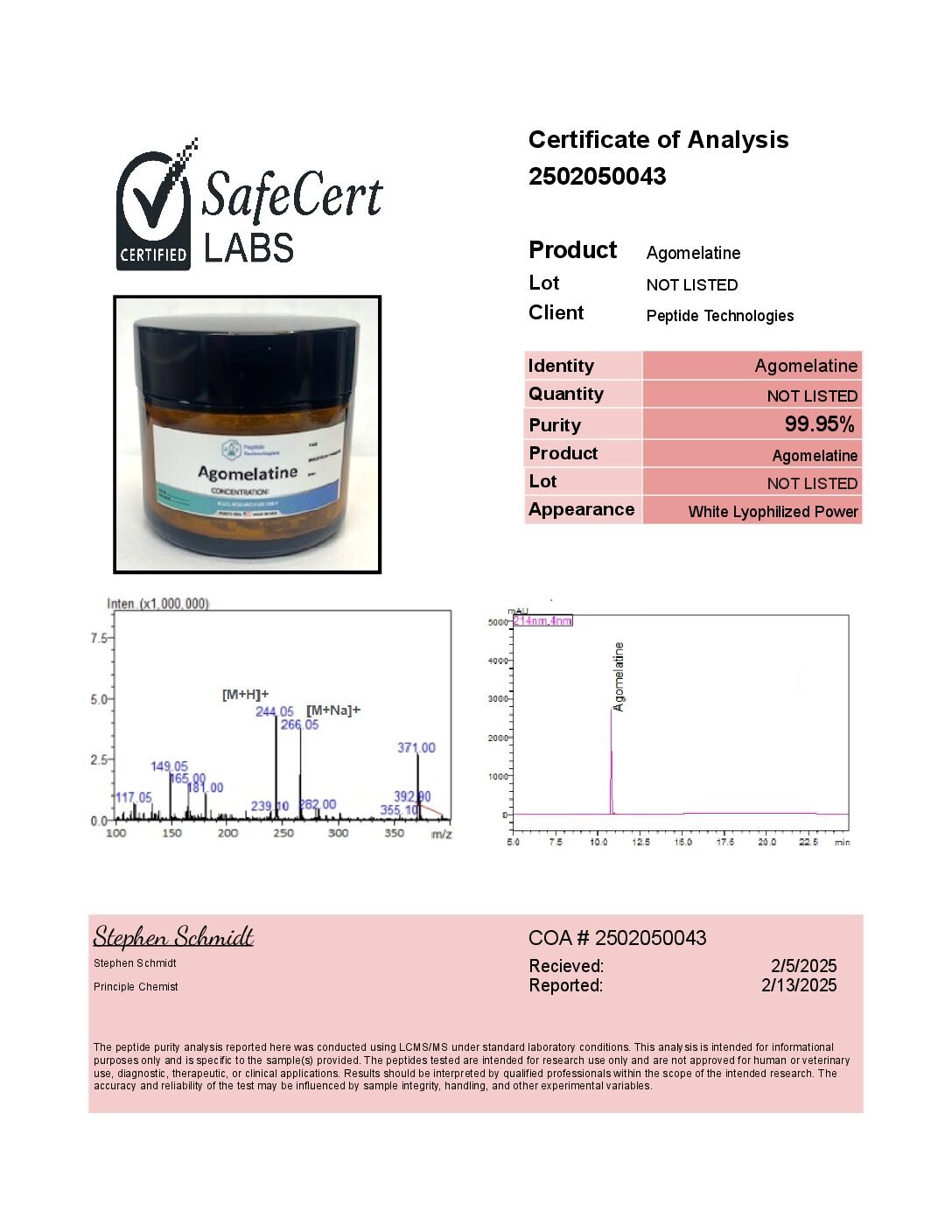
| Purity | ≥ 99% (verified by HPLC & MS; third-party tested) |
| Solubility | Water: insoluble. DMSO: ≥48–50 mg/mL; Ethanol: up to ~48 mg/mL. For limited aqueous work, ~0.5 mg/mL in 1:1 ethanol:PBS (pH 7.2) has been reported—prepare fresh and do not store >1 day. Prepare concentrated organic stocks, then dilute into assay buffer (<1–2% organic v/v); 0.22 µm filter if clarity is required. |
Molecular Structure (Reference)
Why Peptide Tech
- Same-Day Shipping
- GMP-Aligned Lyophilized Peptides
- USA Made
- 24/7 Support
- Price Match Guarantee
- Batch Tracking with QR Code Verification
- 3rd-Party USA Lab Testing — purity, quantity, endotoxin
- Cold-Chain Shipping — Always (no paid upgrade)
- Worldwide Shipping
- All Major Payments Accepted
- Text & Email Order Updates
- 2-Day FedEx/UPS Shipping Standard
- Cheapest Overnight Rates
- Largest Variety of Peptides & Bioregulators
Storage & Handling
- Solid (unopened): Store sealed at 2–8 °C, protected from light and moisture. For long-term archival, ≤ −20 °C is recommended.
- Solutions: Aliquot DMSO/EtOH stocks into low-binding tubes; store at ≤ −20 °C. Avoid repeated freeze–thaw cycles.
- Handling: Allow container to equilibrate to room temperature before opening to minimize condensation; reseal promptly.
- Research Use Only (RUO): Not for human or veterinary use, ingestion, diagnostic, or therapeutic applications.
Potential Applications in Research
Strictly in-vitro, cellular, or biochemical contexts — no clinical or human-use claims.
- MT1/MT2 receptor binding: Displacement of radioligands (e.g., 2-[125I]-iodomelatonin) to profile affinity/selectivity vs. melatonin and analogs.
- Gi/o signaling assays: Quantify inhibition of cAMP accumulation and β-arrestin recruitment in MT1/MT2-expressing cells.
- 5-HT2C functional antagonism: Measure IP1/Ca2+ pathway readouts in 5-HT2C systems and compare to selective antagonists.
- Circadian reporter models: Evaluate clock-gene (e.g., Per/CRE-luc) phase-shifting/entrainment in cellular systems.
- Pathway cross-talk: Study convergence of melatonergic and serotonergic signaling in co-expression paradigms.
- SAR benchmarking: Use as a reference ligand when profiling racetam/indole/naphthalene analogs at MT1/MT2 and 5-HT2C.
Citations (PubMed)
- Millan, M. J., et al. “The novel melatonin agonist agomelatine (S20098) is an antagonist at 5-HT2C receptors: blockade of the latter reinforces frontocortical adrenergic and dopaminergic transmission.” Neuropsychopharmacology, 2003. PubMed
- Guardiola-Lemaitre, B., et al. “Agomelatine: mechanism of action and pharmacological profile.” Expert Opin Drug Metab Toxicol, 2014. PubMed / PMC
- Liu, J., et al. “MT1 and MT2 Melatonin Receptors: A Therapeutic Perspective.” J Med Chem, 2016 (review of MT1/MT2 pharmacology; discusses agomelatine). PMC
- Chagraoui, A., et al. “Agomelatine (S 20098) antagonizes 5-HT2C receptor-mediated responses in vivo.” Psychopharmacology, 2003. PubMed
Compliance & RUO Disclaimer
For laboratory research use only (RUO). Not a drug, food, or cosmetic. Not for human or veterinary use. Purchase and use are limited to qualified personnel operating under institutional laboratory guidelines.
Related products
New
New
New
New
New
New